Quick answer: The federal EV charger tax credit (Section 30C) expired June 30, 2026 and was not renewed. Utility rebates are what’s left — and they are shrinking too. We re-verified every program on this page against the utilities’ own sites in October 2026: LADWP (up to $1,000), PG&E, Eversource and National Grid in Massachusetts (up to $700–$1,700) are open — but both Massachusetts programs have 2026 deadlines (Eversource November 1, National Grid December 10) — while ComEd’s Illinois program has closed and reopens January 1, 2027 with an announced standard rebate cut from $1,000 to $750.
Last verified: October 11, 2026, against each utility’s own program page (not third-party rebate roundups, which we found to be materially out of date). Incentive programs change frequently and can pause when funds run out — always confirm current status directly with the provider before you buy. Sources in the methodology section.
What changed since our last check
We re-verify this page monthly because incentives are the most volatile data on this site. Between our July 6 and August 7 checks, three of the programs we listed had changed — which is the real lesson of this page. Our October 11 check found more:
- Eversource (Massachusetts) set a deadline. The current program ends December 31, 2026, and applications — complete, with Managed Charging enrollment — must be submitted by November 1, 2026. Eversource says it is awaiting approval of a 2027 program and expects the structure and incentives to change.
- National Grid (Massachusetts) set a deadline too. Eligible work must be completed and the application submitted by December 10, 2026; incentives are expected to change in 2027. Its page also lists tiers we had not shown: up to $1,000 in environmental-justice communities and, on the R-2 discount rate, up to $1,000 for wiring plus $700 toward a qualified smart charger (both enhanced tiers require an EV purchase price of $55,000 or less). Enrolling in the Off-Peak Charging program is required for single-family homes.
- PG&E renamed its program to Residential EV Charging. Amounts are unchanged.
From our August check:
- ComEd (Illinois) closed its residential program. Its own page now carries a notice that applications resume January 1, 2027, and that installations completed in 2026 will not be eligible for 2027 funding. If you were counting on ComEd money for an install this year, it is not there.
- ComEd cut the standard rebate by 25% for 2027 — $750, down from $1,000. The low-income/EIEC rebate holds at $2,500. (Announced by ComEd; not yet confirmed as of October 2026 — ComEd’s program terms confirm the 2026 closure, but we could not re-read the 2027 amounts on its site in October.)
- Eversource (Massachusetts) added a condition. As of March 2, 2026, anyone taking a charger or wiring-upgrade rebate must enroll in Eversource’s Managed Charging program, which lets the utility shift when your car draws power.
Third-party “EV rebate” roundups — including several ranking on page one — still list ComEd’s 2026 program as open. Check the utility’s own page, or you will plan around money that isn’t there.
The durable way to find your rebate (works in any year)
Rebate programs open, close, and change amounts constantly, so the reliable skill isn’t memorizing a list — it’s knowing where to look. Check these three, in order:
- DSIRE (dsireusa.org) — the Database of State Incentives for Renewables & Efficiency, run by NC State. Search your ZIP code for every federal, state, utility, and local program. This is the single best starting point.
- Your electric utility’s website — look for an “electric vehicles,” “EV charging,” or “electrification” section. Utility rebates are the most common source of home-charger money in 2026, and only your utility has the current terms.
- Your state energy office / clean-transportation program — some states (California’s DriveClean, for example) run their own portals that aggregate what’s available locally.
Programs we verified this month
Every row below was read off the utility’s own page on October 11, 2026 (ComEd’s 2027 amounts are as announced by ComEd; not yet confirmed as of October 2026). In August we removed two programs that appeared in our July version because we could not re-confirm their current amounts from the provider — a listing we can’t verify is worse than no listing.
| State | Program | Status (Oct 11, 2026) | Rebate |
|---|---|---|---|
| California | LADWP residential EV charger | Open | Up to $1,000; +$500 for Lifeline/EZ-SAVE customers |
| California | PG&E Residential EV Charging — Standard | Open | 50% of charging equipment (no income test) |
| California | PG&E Residential EV Charging — Rebate Plus | Open, income-qualified | Up to $2,000 install; up to $5,000 with a panel upgrade |
| Massachusetts | Eversource wiring/panel upgrade | Open — applications due Nov 1, 2026; program ends Dec 31, 2026 | $700 standard · $1,000 environmental-justice · $1,700 discount-rate (incl. charger); Managed Charging enrollment required |
| Massachusetts | National Grid EV Charging Upgrade | Open — work done and application in by Dec 10, 2026 | Up to $700 standard · $1,000 environmental-justice · R-2 discount rate $1,000 wiring + $700 charger (single-family; more for 2–4 units); Off-Peak Charging enrollment required |
| New York | Con Edison SmartCharge New York | Open | 10¢/kWh off-peak; ~$400/year average participant earnings |
| Illinois | ComEd residential charger + install | Closed — reopens Jan 1, 2027 | $750 standard · $2,500 LI/LIC/EIEC (2027 rates as announced by ComEd; not yet confirmed as of October 2026) |
Why this list is short on purpose: we only include programs we could confirm from the provider’s own page this month. There are hundreds of smaller municipal and co-op utility programs DSIRE will surface for your specific address that aren’t listed here. Your ZIP code is the real lookup — this table shows the shape of what’s out there and how fast it moves.
What a charger actually costs you after the rebate
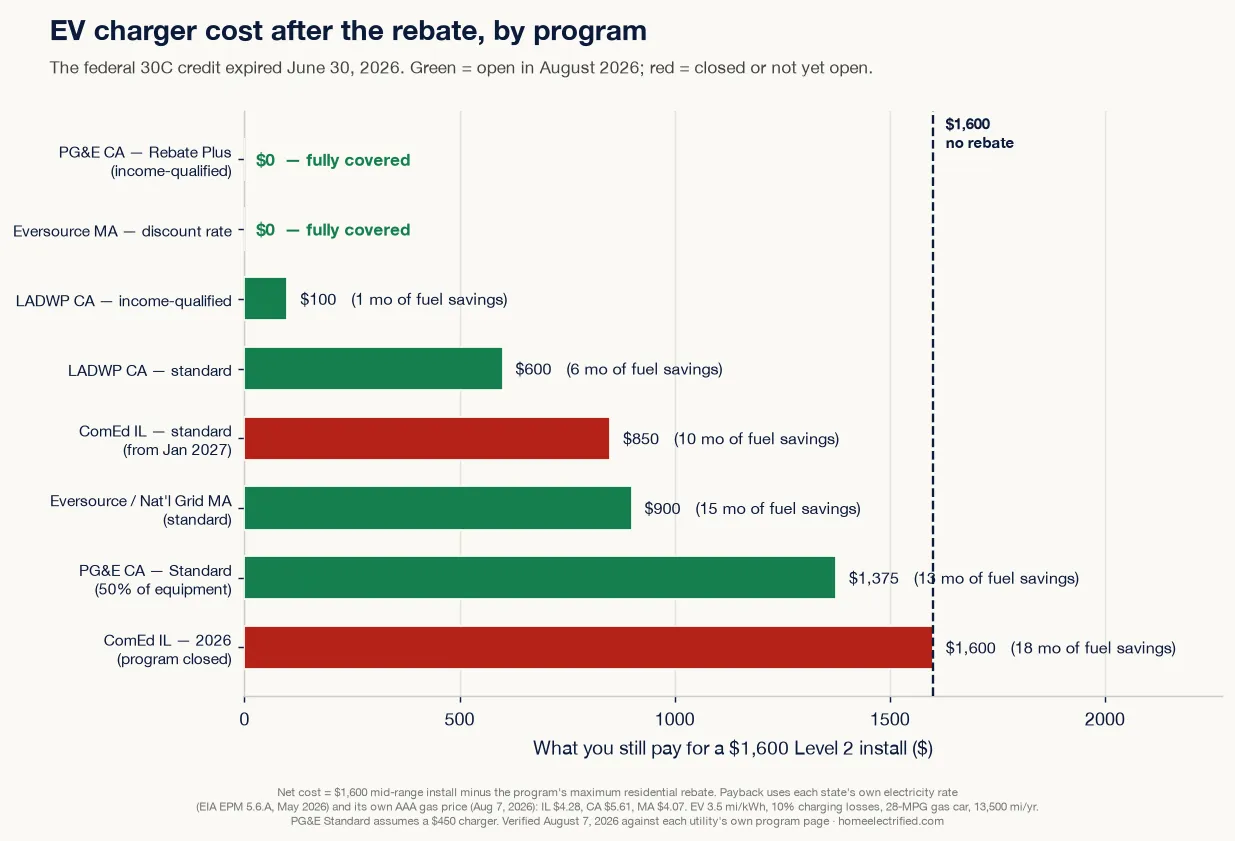
This is the number that matters, and nobody publishes it: take a typical $1,600 mid-range Level 2 installation, subtract the rebate, then see how many months of fuel savings clear the balance — using each state’s own electricity rate and its own gas price, not a national average.
| Program | Rebate | Net install cost | Fuel saving in that state | Pays for itself in |
|---|---|---|---|---|
| PG&E Rebate Plus (CA, income-qualified) | $2,000 | $0 | $1,294/yr | immediately |
| LADWP income-qualified (CA) | $1,500 | $100 | $1,294/yr | 1 month |
| Eversource discount rate (MA) | $1,700 | $0 | $739/yr | immediately |
| LADWP standard (CA) | $1,000 | $600 | $1,294/yr | 5.6 months |
| Eversource / National Grid environmental-justice (MA) | $1,000 | $600 | $739/yr | 9.7 months |
| ComEd standard — from Jan 2027 (IL) | $750 | $850 | $1,052/yr | 9.7 months |
| Eversource / National Grid standard (MA) | $700 | $900 | $739/yr | 14.6 months |
| PG&E Standard (CA, 50% of a $450 charger) | ~$225 | $1,375 | $1,294/yr | 12.8 months |
| ComEd in 2026 — program closed (IL) | $0 | $1,600 | $1,052/yr | 18.2 months |
Assumptions: $1,600 mid-range install (our Level 2 installation cost guide puts installation at $800–$3,000 plus $100–$800 for the charger); 3.5 mi/kWh EV, 28 MPG gas comparison car, 13,500 miles/year, 10% Level 2 charging losses. Electricity rates are EIA May 2026 state data; gas prices are AAA state averages retrieved August 7, 2026 (IL $4.28, CA $5.61, MA $4.07, NY $4.18). PG&E Standard assumes a $450 charger, the midpoint of the typical $300–$600 hardware range.
Two things fall out of this table:
- Even with no rebate at all, the install pays for itself in about 18 months in Illinois — and roughly 14 months at the U.S. average (October 2026 rates and gas). The rebate accelerates a payback that was already happening; it is not what makes home charging worth it.
- The income-qualified tiers are dramatically better than the standard ones — often 3–5× larger. If you might qualify (PG&E uses 80% of area median income; ComEd uses 80% of statewide median), check before you assume you don’t. That is where the real money is in 2026.
Beyond rebates: the off-peak rate that usually beats them
The biggest ongoing saving usually isn’t a one-time rebate — it’s a time-of-use (TOU) EV rate plan. Con Edison’s SmartCharge New York is the clearest published example: 10¢/kWh back for charging off-peak, worth about $400 a year to the average participant, per Con Edison’s own figures. That recurs every year, while a rebate lands once.
Two cautions from this month’s verification. Con Edison excludes customers already on a residential TOU rate from earning SmartCharge incentives — you can enroll, but you won’t collect. And ComEd requires enrolling in one of its time-variant supply rates for at least three years to qualify for its rebate. Read the rate condition before you take the money.
Put it in context
A typical Level 2 charger installation runs $800–$3,000 plus $100–$800 for the charger, and home charging saves the average U.S. driver about $1,329/year versus gas (October 2026) (full 50-state breakdown). Charging costs vary nearly 4× by state — from about $10.50 for a full charge in Louisiana to $40 in Hawaii — so your rebate matters less than your rate. Run your own numbers with the EV charging cost calculator, or see what it costs to charge specific models.
Methodology & sources
Re-verified October 11, 2026, by reading each utility’s own program page:
- ComEd (IL): Electric Vehicle Charger and Installation Rebate — program notice (applications resume Jan 1, 2027; 2026 installs ineligible for 2027 funding) and the 2027 rebate tables ($2,500 LI/LIC/EIEC; $750 standard), read August 7, 2026. In October the 2026 closure was confirmed against ComEd’s program Terms & Conditions (v3.0, March 31, 2026); the 2027 amounts are announced by ComEd; not yet confirmed as of October 2026.
- PG&E (CA): Residential EV Charging rebate (formerly Residential Charging Solutions; the page URL is unchanged) — Standard (up to 50% of equipment) and Rebate Plus (up to $2,000 install; up to $5,000 with panel upgrade, at under 80% of area median income).
- LADWP (CA): LADWP residential EV charger rebate for the $500 income-qualified adder, cross-checked against the California Energy Commission’s DriveClean program listing for the up-to-$1,000 base rebate.
- Eversource (MA): Electric Vehicle Home Charging Rebates in Massachusetts — tiered wiring/panel amounts, the March 2, 2026 Managed Charging requirement, and the November 1, 2026 application deadline (program ends December 31, 2026).
- National Grid (MA): EV Charging Upgrade Program — up to $700 for single-family homes, $1,000 in environmental-justice communities, R-2 discount rate $1,000 wiring + $700 charger; Off-Peak Charging enrollment required; December 10, 2026 deadline.
- Con Edison (NY): SmartCharge New York — 10¢/kWh off-peak incentive, ~$400/year average participant earnings, and the TOU-rate exclusion.
- Federal 30C expiration (June 30, 2026): confirmed against Rewiring America, Plug In America, and the DOE Alternative Fuels Data Center (post-OBBBA guidance).
- DSIRE: recommended as the authoritative, address-level program database.
- Cost and savings inputs: electricity rates from EIA Electric Power Monthly Table 5.6.A (May 2026 state data); gas prices from AAA state averages retrieved August 7, 2026 — the payback table still uses these August inputs (the October 11 re-verification updated program status and amounts, not the payback math); the national saving and full-charge range above use EIA July 2026 data and AAA prices from October 10, 2026; installation ranges cross-referenced from EnergySage and Qmerit.
Removed this month: United Power (CO) and Alameda Municipal Power (CA) appeared in our July table at $500 each. We could not re-confirm current residential amounts from either provider in August, so we removed them rather than republish a figure we hadn’t checked. Both may still offer rebates — ask them directly.
These are planning figures, not quotes. Incentives are the most volatile data on this site, and this page is re-verified monthly; the “verified” date above reflects the latest check. If a listed program has changed, treat the provider’s current terms as correct over this page.
Frequently asked questions
Is there still a federal tax credit for home EV chargers in 2026?
No. The federal Section 30C credit (30% of cost, up to $1,000) expired June 30, 2026 under the One Big Beautiful Bill Act. Chargers had to be installed and operational by that date to qualify. Many websites still list it as available — they are out of date.
What EV charger rebates can I still get in 2026?
Utility rebates, which the federal expiration did not affect. Verified as open in October 2026: LADWP up to $1,000 ($1,500 income-qualified), PG&E up to 50% of equipment ($2,000–$5,000 income-qualified), Eversource Massachusetts up to $700–$1,700 (applications due November 1, 2026), and National Grid Massachusetts up to $700, $1,000 in environmental-justice areas, or $1,000 plus $700 toward a charger on the R-2 discount rate (applications due December 10, 2026). Amounts and availability change as funds run out.
Is the ComEd EV charger rebate still available?
Not for 2026 installations. ComEd's residential program is closed and reopens for applications on January 1, 2027 — and installations completed in 2026 will not be eligible for 2027 funding. ComEd has announced a 2027 standard rebate of $750, down from $1,000 in 2026, with the low-income/EIEC rebate staying at $2,500 — announced by ComEd; not yet confirmed as of October 2026.
How do I find EV charger rebates in my area?
Check three places: the DSIRE database (dsireusa.org) for a searchable list of all programs, your electric utility's EV or electrification page, and your state energy office. Utility programs are the most common source of home-charger money in 2026, and only your utility has the current terms.
Are there rebates for the wiring or panel upgrade, not just the charger?
Yes, and in Massachusetts that is the whole point of the program. Eversource pays up to $700 for wiring or panel upgrades on standard rates, up to $1,000 in environmental justice communities, and up to $1,700 for discount-rate customers. National Grid pays up to $700 for single-family homes, up to $1,000 in environmental-justice communities, and up to $1,000 for wiring plus $700 toward a charger for customers on its R-2 low-income discount rate. Both programs require enrolling in the utility's managed or off-peak charging program.
Do utility rebates and the federal credit stack?
They used to — most utility programs were designed to stack with the federal 30C credit. Since 30C expired June 30, 2026, new installations can only claim the utility side. Installs completed before that date may still claim both.