Quick answer: It genuinely depends on where you live. At the U.S. average electricity rate (18.31¢/kWh) and cheap natural gas ($1.56/therm), a heat pump at a seasonal COP of 3.0 costs about $17.89 to deliver a million BTU of heat, versus about $16.42 for a modern 95%-efficient gas furnace — so gas is slightly cheaper at the national average. But the break-even is about 16.8¢/kWh: in the roughly half of U.S. states with cheaper electricity, the heat pump wins on running cost. Against an older 80% furnace, the heat pump is cheaper to run in most states. Run your own numbers below.
Last verified: October 10, 2026. Electricity rates: EIA (July 2026, latest state-level). Natural gas: EIA U.S. average $1.56/therm (March 2026 — the most recent heating-season month; see methodology). Efficiency assumptions in the methodology section.
Calculate your break-even
Heat Pump vs Gas Furnace: Running-Cost Calculator
Which actually costs less to run for heat? It depends on your state's electricity price, your gas price, and efficiency. Live July 2026 data pre-loaded — edit anything.
Heating need: a typical U.S. home uses ~30–80 million BTU/year for heat depending on climate and size (50 is a common middle). One therm on your gas bill = 0.1 million BTU. A heat pump also replaces your air conditioner and can't be compared on heat cost alone — see the article. Electricity: EIA Electric Power Monthly (July 2026, latest state-level), retrieved October 10, 2026. Gas default: EIA U.S. average $1.56/therm (March 2026, the most recent heating-season month — summer $/therm runs higher because fixed monthly charges spread over very low usage, which would overstate winter heating cost). Estimates only, not a quote.
Why “it depends” is the honest answer
Most articles tell you a heat pump always saves money. That’s not true on running cost alone, and here’s the physics of why:
- A gas furnace burns fuel — a 95% AFUE furnace turns 95% of a therm into useful heat. Cost to deliver a million BTU = (10 ÷ AFUE) × gas price per therm.
- A heat pump moves heat instead of making it, so it delivers more heat energy than the electricity it consumes. At a seasonal COP of 3.0 it delivers 3 units of heat per unit of electricity. Cost per million BTU = (1,000,000 ÷ (3,412 × COP)) × electricity price.
Plug in the national averages and the two land close together — which means the winner flips based on your local prices. Two numbers decide it: your electricity-to-gas price ratio, and your heat pump’s COP.
Heat pump vs gas furnace heating cost, by state (2026)
Cost to deliver one million BTU of heat, heat pump at COP 3.0 vs gas at $1.56/therm. Green = the heat pump beats even a modern 95% furnace; states above $16.42 still beat an old 80% furnace (up to $19.50) but not new gas.
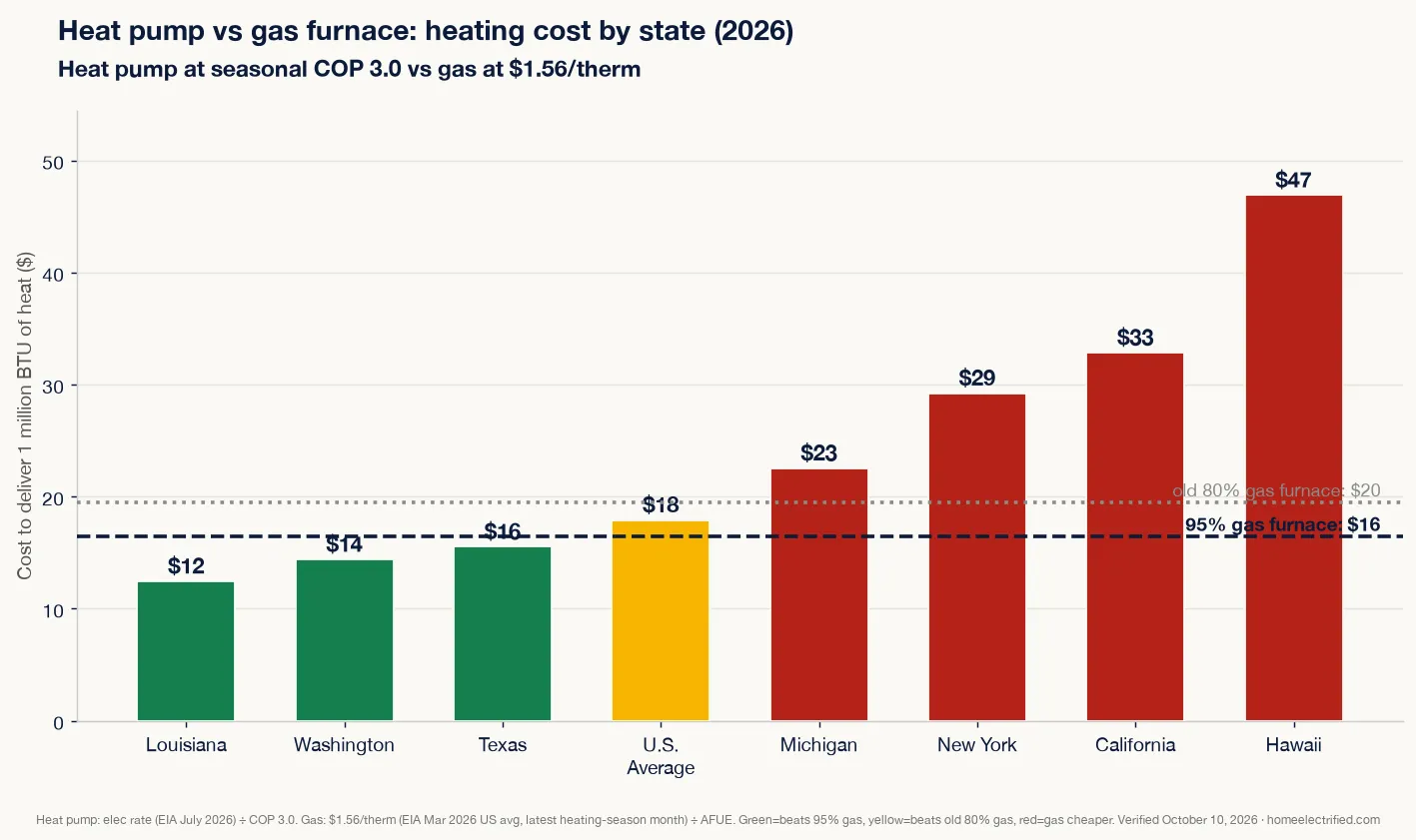
| State | Electricity rate | Heat pump $/million BTU | vs new 95% gas ($16.42) | vs old 80% gas ($19.50) |
|---|---|---|---|---|
| Louisiana | 12.72¢ | $12.43 | cheaper ✅ | cheaper ✅ |
| Nevada | 12.77¢ | $12.48 | cheaper ✅ | cheaper ✅ |
| Utah | 13.12¢ | $12.82 | cheaper ✅ | cheaper ✅ |
| North Dakota | 13.41¢ | $13.10 | cheaper ✅ | cheaper ✅ |
| Tennessee | 13.71¢ | $13.39 | cheaper ✅ | cheaper ✅ |
| Idaho | 13.73¢ | $13.41 | cheaper ✅ | cheaper ✅ |
| Nebraska | 13.78¢ | $13.46 | cheaper ✅ | cheaper ✅ |
| Kentucky | 13.81¢ | $13.49 | cheaper ✅ | cheaper ✅ |
| Oklahoma | 14.35¢ | $14.02 | cheaper ✅ | cheaper ✅ |
| Washington | 14.71¢ | $14.37 | cheaper ✅ | cheaper ✅ |
| Florida | 15.03¢ | $14.68 | cheaper ✅ | cheaper ✅ |
| North Carolina | 15.16¢ | $14.81 | cheaper ✅ | cheaper ✅ |
| Arizona | 15.38¢ | $15.03 | cheaper ✅ | cheaper ✅ |
| Texas | 15.88¢ | $15.51 | cheaper ✅ | cheaper ✅ |
| Oregon | 15.97¢ | $15.60 | cheaper ✅ | cheaper ✅ |
| Iowa | 15.99¢ | $15.62 | cheaper ✅ | cheaper ✅ |
| Georgia | 16.27¢ | $15.89 | cheaper ✅ | cheaper ✅ |
| Indiana | 16.73¢ | $16.34 | cheaper ✅ | cheaper ✅ |
| Colorado | 17.00¢ | $16.61 | pricier | cheaper ✅ |
| Minnesota | 17.45¢ | $17.05 | pricier | cheaper ✅ |
| Virginia | 17.55¢ | $17.15 | pricier | cheaper ✅ |
| U.S. Average | 18.31¢ | $17.89 | pricier | cheaper ✅ |
| Wisconsin | 19.06¢ | $18.62 | pricier | cheaper ✅ |
| Illinois | 19.22¢ | $18.78 | pricier | cheaper ✅ |
| Ohio | 19.45¢ | $19.00 | pricier | cheaper ✅ |
| Pennsylvania | 21.72¢ | $21.22 | pricier | pricier |
| Michigan | 23.05¢ | $22.52 | pricier | pricier |
| New Jersey | 25.19¢ | $24.61 | pricier | pricier |
| New York | 29.90¢ | $29.21 | pricier | pricier |
| Massachusetts | 30.49¢ | $29.79 | pricier | pricier |
| California | 33.61¢ | $32.84 | pricier | pricier |
| Hawaii | 48.00¢ | $46.89 | pricier | pricier |
(Selected states; use the calculator for any state and your own gas price and efficiency.)
When a heat pump clearly wins — and when it’s closer
The heat pump is a running-cost slam dunk if you’re replacing:
- Electric resistance heat (baseboards, furnace) — a heat pump uses ~⅓ the electricity for the same heat.
- Heating oil or propane — both are far more expensive per BTU than natural gas, so a heat pump beats them almost everywhere.
- An old 80% gas furnace in most states (see the last column above).
It’s genuinely closer if you have cheap natural gas and expensive electricity (much of the Northeast, California). There, the heat pump may cost a bit more to run for heat — but three things still tip the scales:
- It replaces your air conditioner too, so you’re buying one system instead of two.
- Off-peak / TOU electricity rates (30–50% cheaper overnight) can flip the math back in the heat pump’s favor.
- Emissions and comfort — modern inverter heat pumps heat more evenly and cut carbon.
What about the upfront cost?
Running cost is only half the picture — see how much a heat pump costs to install ($6,000–$13,000 for a whole-home air-source system) and remember the federal tax credits expired at the end of 2025, so state and utility rebates are now the way to cut the sticker price.
Methodology & sources
Re-verified October 10, 2026:
- Electricity rates: EIA Electric Power Monthly (July 2026 state-level data, retrieved October 10, 2026); U.S. average 18.31¢/kWh.
- Natural gas price: EIA U.S. average residential price, ~$1.56/therm (derived from $16.16 per thousand cubic feet, March 2026 as revised in EIA’s September 30, 2026 release), re-checked October 10, 2026. We deliberately use the most recent heating-season month rather than the newest data point: residential $/therm rises sharply in summer (July 2026 was $26.45/Mcf ≈ $2.55/therm) because fixed monthly customer charges spread over very low warm-weather usage, which would overstate winter heating cost. State gas prices vary widely (in March 2026, under $1/therm in Idaho and North Dakota to about $5.88 in Hawaii) — the calculator lets you enter yours.
- Efficiency assumptions: heat pump seasonal COP 3.0 (typical for modern air-source; cold-climate models hold 2.0–3.0 at 0°F, mild climates reach 3.5+); gas furnace 95% AFUE for new, 80% for older units. Physics: 1 therm = 100,000 BTU, 1 kWh = 3,412 BTU.
- Break-even: electricity rate where heat pump cost = gas cost = (10 ÷ AFUE) × gas price × COP ÷ 293.08. At COP 3.0 and $1.56/therm: 16.8¢/kWh vs 95% gas, 20.0¢/kWh vs 80% gas.
- Figures are planning estimates; your real COP depends on your climate and equipment, and your gas price on your utility.
Rates and gas prices change monthly; this page is re-verified on a schedule and the “verified” date reflects the latest check.
Frequently asked questions
Is a heat pump cheaper to run than a gas furnace?
It depends on your electricity price, your gas price, and efficiency. At a seasonal COP of 3.0, a heat pump beats a modern 95%-efficient gas furnace on running cost wherever electricity is below about 16.8¢/kWh — which is roughly half of U.S. states. Against an older 80% furnace, the break-even rises to about 20.0¢/kWh, so the heat pump wins in most states.
How much does it cost a heat pump to produce heat?
At a seasonal COP of 3.0 and the U.S. average electricity rate (18.31¢/kWh), a heat pump costs about $17.89 to deliver one million BTU of heat. In a cheap-electricity state like Louisiana (12.72¢) it's about $12; in an expensive one like California (33.61¢) it's about $33.
What is a good COP for a heat pump?
Seasonal COP (real-world average over the heating season) for air-source heat pumps typically runs 2.0–3.5. Modern cold-climate models hold a COP of 2.0–3.0 even at 0°F. A higher COP means lower running cost — it's the single biggest factor in whether a heat pump beats gas.
Does a heat pump save money if I have cheap natural gas?
Often not on heating cost alone. Where natural gas is cheap and electricity is expensive (much of the Northeast and California), a gas furnace can be cheaper to run. But a heat pump also replaces your air conditioner, works on cheaper off-peak electricity plans, and cuts emissions — so 'worth it' isn't only about the heating bill.
What's the break-even electricity price for a heat pump vs gas?
At a COP of 3.0 and gas at $1.56/therm, a heat pump matches a 95%-efficient gas furnace at about 16.8¢/kWh, and an older 80% furnace at about 20.0¢/kWh. Below those prices the heat pump is cheaper to run; above them, gas is. Use the calculator to find your exact break-even.