Quick answer: Most U.S. homeowners pay $800–$3,000 plus $100–$800 for the charger for a professionally installed Level 2 EV charger in 2026. Most quality chargers are $300–$600; the installation side is electrical work — wiring, labor, permits, and (the big variable) whether your panel needs an upgrade. A simple install near the panel runs about $900–$1,300; add a panel upgrade or a long wire run and you’re looking at $2,000–$3,500.
Last verified: October 11, 2026 for the installation cost range (re-checked against EnergySage’s guide, updated June 22, 2026, which quotes $800–$3,000 before equipment); scenario totals from July 5, 2026; the cross-referenced home-charging savings and payback figures were refreshed October 10, 2026. Cost figures cross-referenced from EnergySage, Qmerit, and 2026 installer guides — sources and dates in the methodology section.
What you’re actually paying for
| Component | Typical 2026 cost |
|---|---|
| Level 2 charger (hardware) | $100–$800 (most: $300–$600) |
| Adding a 240V circuit | $60–$150 |
| Electrician labor + wiring | varies with distance & route (bulk of the bill) |
| Permit | $50–$800 (average: $297) |
| Sub-panel (if needed) | $500–$1,500 |
| Main service upgrade (if needed) | $1,500–$4,000+ |
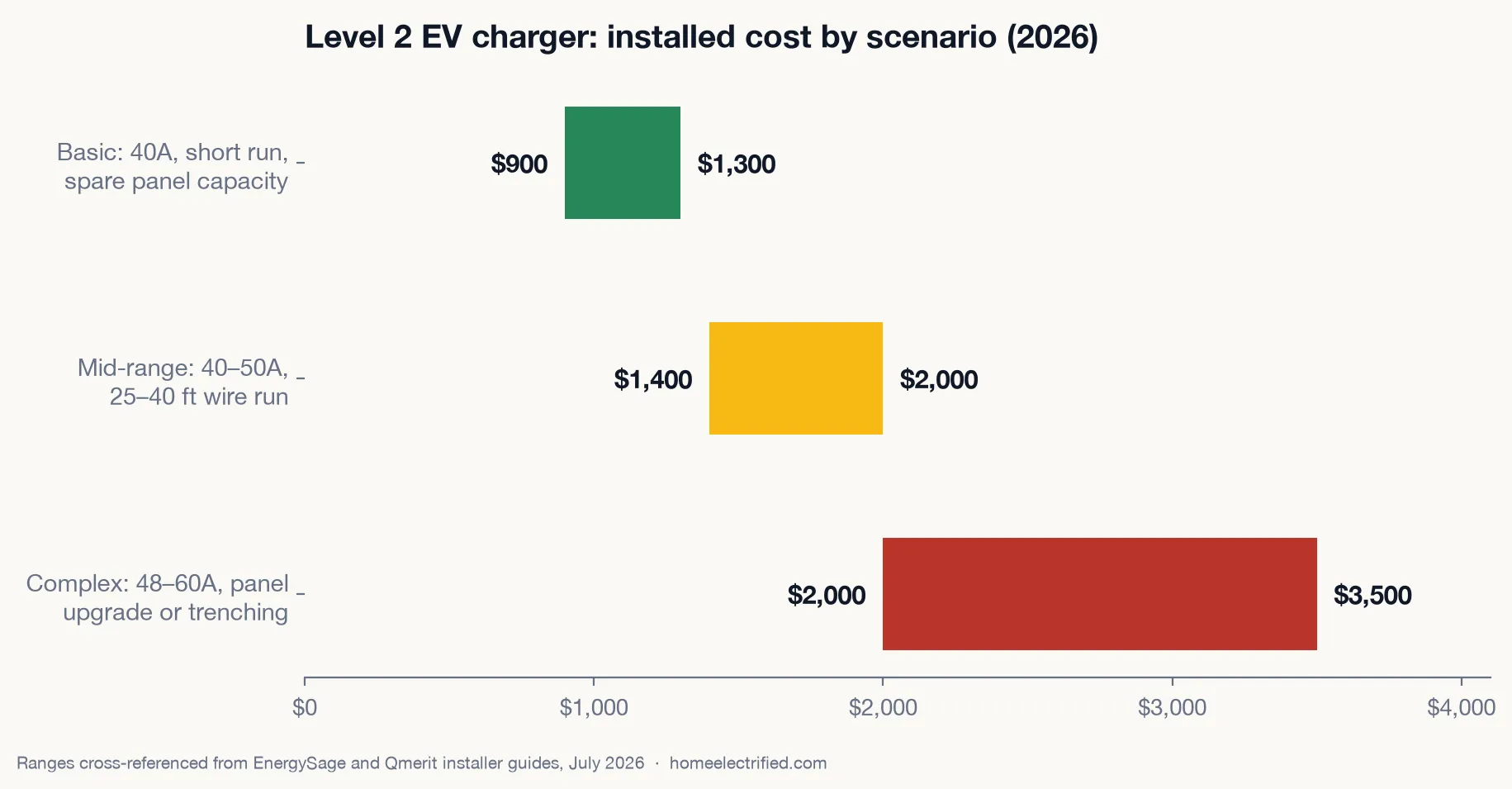
Total by scenario:
| Scenario | Typical all-in cost |
|---|---|
| Basic: 40A charger, short run, spare panel capacity | $900–$1,300 |
| Mid-range: 40–50A, 25–40 ft wire run | $1,400–$2,000 |
| Complex: 48–60A, panel upgrade or trenching | $2,000–$3,500 |
Outdoor installations typically add $200–$1,000 over an equivalent indoor setup.
The three things that decide your price
-
Distance from your electrical panel. Wire (and the labor to run it) is priced by the foot. A charger on the same wall as the panel might cost a third of one across the house or out to a detached garage (trenching for underground conduit is what pushes bills past $3,000).
-
Your panel’s spare capacity. A 240V/40–50A circuit needs room in your panel. If you have it, this is a cheap line item ($60–$150 for the circuit). If you don’t, you’re into a sub-panel ($500–$1,500) or a full service upgrade ($1,500–$4,000+) — the single biggest cost swing in the whole project. Our electrical panel upgrade cost guide breaks down what that upgrade includes and how much it stretches your charger’s payback.
-
Wiring route complexity. Fishing wire behind finished walls, through crawl spaces, or underground costs more than a straight shot through an unfinished garage. Regional labor rates compound this — the same job prices very differently in San Francisco and Oklahoma City.
How to keep the cost down (legitimately)
- Get 2–3 quotes. Labor is most of the bill and quotes for identical work commonly vary by hundreds of dollars.
- Ask about a load-management device before agreeing to a panel upgrade. If your panel is near capacity, a load controller (which pauses charging while high-draw appliances run) can often avoid a $1,500–$4,000 service upgrade entirely — ask the electrician to price both options.
- Place the charger near the panel if you can. Every foot of wire you don’t need is money saved.
- Consider a 40A charger instead of 60A. It still adds ~25–30 miles of range per hour — a full overnight charge for almost anyone — and may spare you the panel work a bigger unit triggers.
- Check state and utility rebates — several still pay $700–$2,000+, and the income-qualified tiers can cover the whole job. See our verified 2026 EV charger rebate list.
The federal tax credit is gone — here’s what’s left
The federal Section 30C credit — 30% of hardware plus installation, up to $1,000 — expired June 30, 2026 under the One Big Beautiful Bill Act, and no extension is pending. The charger had to be operational by that date to qualify. If yours was, claim it on your 2026 return; if you’re installing now, the federal incentive is off the table.
Still available in many areas:
- Utility rebates — the programs we verified in August 2026 pay $700–$1,000 on standard tiers and $1,500–$5,000 for income-qualified customers (the full verified list)
- Discounted off-peak EV rate plans — often a bigger lifetime saving than any rebate (30–50% off your effective charging rate)
- State programs — a patchwork; check your state energy office and utility before you buy hardware
Is it worth it? The payback math
At national averages, home charging saves a typical driver about $1,329 a year versus gas (see our full EV home charging cost breakdown with rates for all 50 states). Against that saving:
- A $1,200 basic install pays for itself in ~11 months
- A $1,600 mid-range install in ~14 months
- Even a $3,000 complex install in ~2.3 years
A rebate shortens all of these. See which EV charger rebates are still open in 2026 — we re-verify every program monthly against the utility’s own page, and several changed in August.
Run your own numbers — your state’s electricity rate, your mileage, your install quote — with our EV charging cost & savings calculator.
Methodology & sources
All figures verified July 5, 2026:
- Component and total costs: EnergySage’s 2026 EV charger installation guide (hardware $100–$800; circuit $60–$150; sub-panel $500–$1,500; service upgrade $1,500–$4,000+; permit $50–$800, avg. $297; installation $800–$3,000 before equipment, per Qmerit data — re-read October 11, 2026), cross-checked against Qmerit and independent 2026 installer guides for scenario ranges.
- 30C expiration: confirmed against Rewiring America, Plug In America, and the DOE Alternative Fuels Data Center (post-OBBBA guidance).
- Payback figures: derived from our EV home charging cost analysis (EIA July 2026 state rates; AAA gas $4.367, October 10, 2026; 13,500 mi/yr; 3.5 mi/kWh; 28 MPG comparison).
Prices change and vary by region — treat ranges as planning figures and get local quotes. This page is re-verified on a scheduled basis.
Frequently asked questions
How much does it cost to install a Level 2 charger at home?
$800–$3,000 plus $100–$800 for the charger for most U.S. homes in 2026. Simple installs with spare panel capacity run $900–$1,300; jobs needing a panel upgrade or long/underground wire runs reach $2,000–$3,500.
How much is the charger itself?
$100–$800, with most quality units at $300–$600. The hardware is usually the smaller share of the total — wiring, labor, and permits make up the rest.
Do I need a permit to install an EV charger?
Almost always, for a hardwired 240V circuit. Permits run $50–$800 depending on jurisdiction (about $297 on average in 2026), and your electrician typically handles it.
Will I need an electrical panel upgrade?
Only if your panel lacks capacity for a 240V/40–50A circuit. If so: a sub-panel costs $500–$1,500 and a main service upgrade $1,500–$4,000+. A load-management device can often avoid the upgrade — ask for both quotes.
Is there still a federal tax credit for EV chargers?
No. The Section 30C credit (30% up to $1,000) expired June 30, 2026, with no extension pending. Installations operational before that date can still be claimed; utility and state rebates remain in many areas.