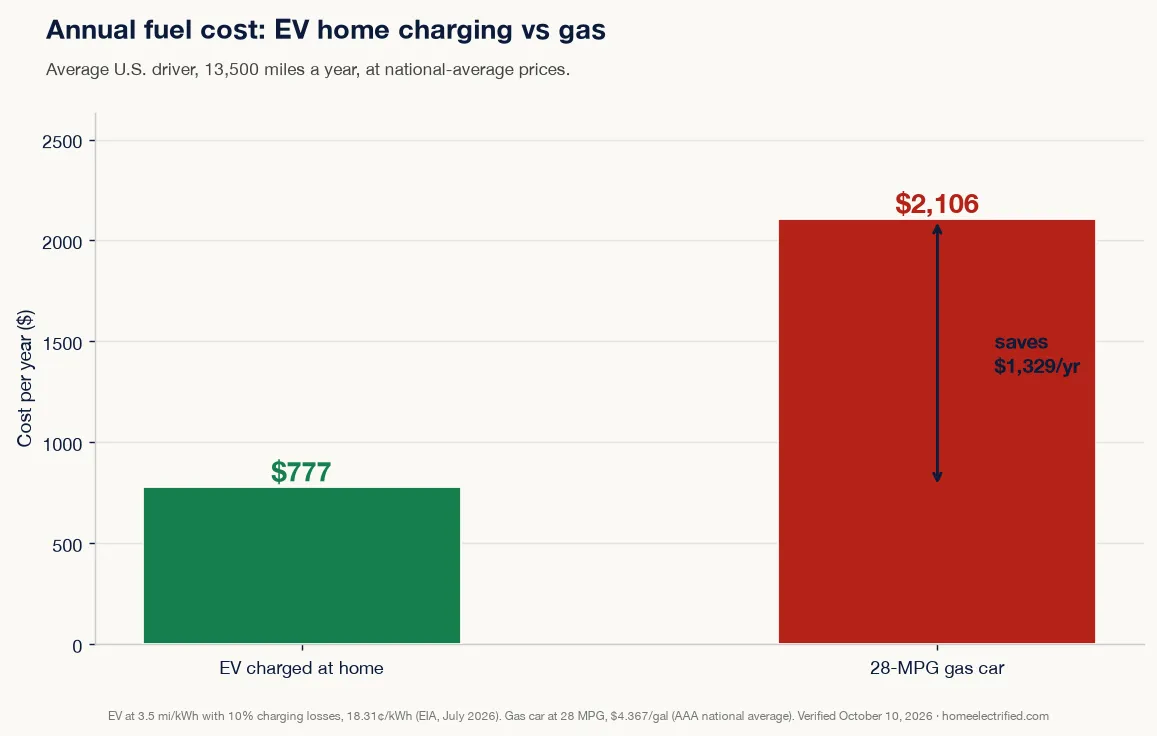
Quick answer: At the current U.S. average residential electricity rate of 18.31¢/kWh, fully charging a typical 75 kWh EV at home costs about $15.11, or roughly 5.8¢ per mile — compared with about 15.6¢ per mile for a 28-MPG gas car at today’s $4.37/gallon national average. For an average driver (13,500 miles/year), that’s about $777 a year in electricity versus $2,106 in gas — a saving of roughly $1,329 a year.
Last verified: October 11, 2026 (Level 2 installation range re-checked); electricity and gas figures October 10, 2026. Electricity rates are the latest state-level EIA data (July 2026); gas prices are AAA national and per-state averages retrieved the same day. Full sources in the methodology section.
Calculate your exact cost
Your real number depends on your state’s electricity rate, your car’s efficiency, and how much you drive. Use the calculator — it’s pre-loaded with the current rate for every state, and every field is editable:
EV Home Charging Cost & Savings Calculator
Live October 2026 data: state electricity rates (EIA) & per-state gas prices (AAA). Pick your state to load both. Every field is editable.
Assumes 10% home-charging losses (typical for Level 2: 5–15%). Electricity rates are statewide residential averages — many utilities offer off-peak EV plans that cut the effective rate 30–50%, so your real cost may be lower. Picking a state loads both its electricity rate and its local gas price, so the comparison stays apples-to-apples. Rates: EIA Electric Power Monthly (July 2026, latest state-level). Gas: AAA state averages, both retrieved October 10, 2026 — override either field with your own price. Estimates only, not a quote.
The math, shown plainly
Home charging cost comes down to one formula:
Cost = (kWh of charge) × (your electricity rate) × (charging losses)
- A typical mid-size EV battery holds 75 kWh and covers ~260 miles.
- Home Level 2 charging wastes about 10% of the electricity as heat and conversion losses (typical range: 5–15%), so you buy ~82.5 kWh to fill a 75 kWh battery.
- At the U.S. average of 18.31¢/kWh: 82.5 × $0.1831 ≈ $15.11 for a full charge, or ~6¢ per mile of range.
Three things move that number most:
- Your state. The same full charge costs $10.49 in Louisiana and $39.60 in Hawaii — nearly a 4× spread.
- Off-peak EV rates. Many utilities offer time-of-use plans that cut the effective overnight rate 30–50%. If you can charge on one, your real cost may be a third lower than the statewide averages below.
- Recent rate inflation. U.S. residential electricity is up ~4.9% year-over-year (July 2026 vs July 2025) — but gas has been more volatile (the national average jumped roughly a dollar in a single month this year), so the EV advantage has held or widened.
EV charging cost by state (October 2026)
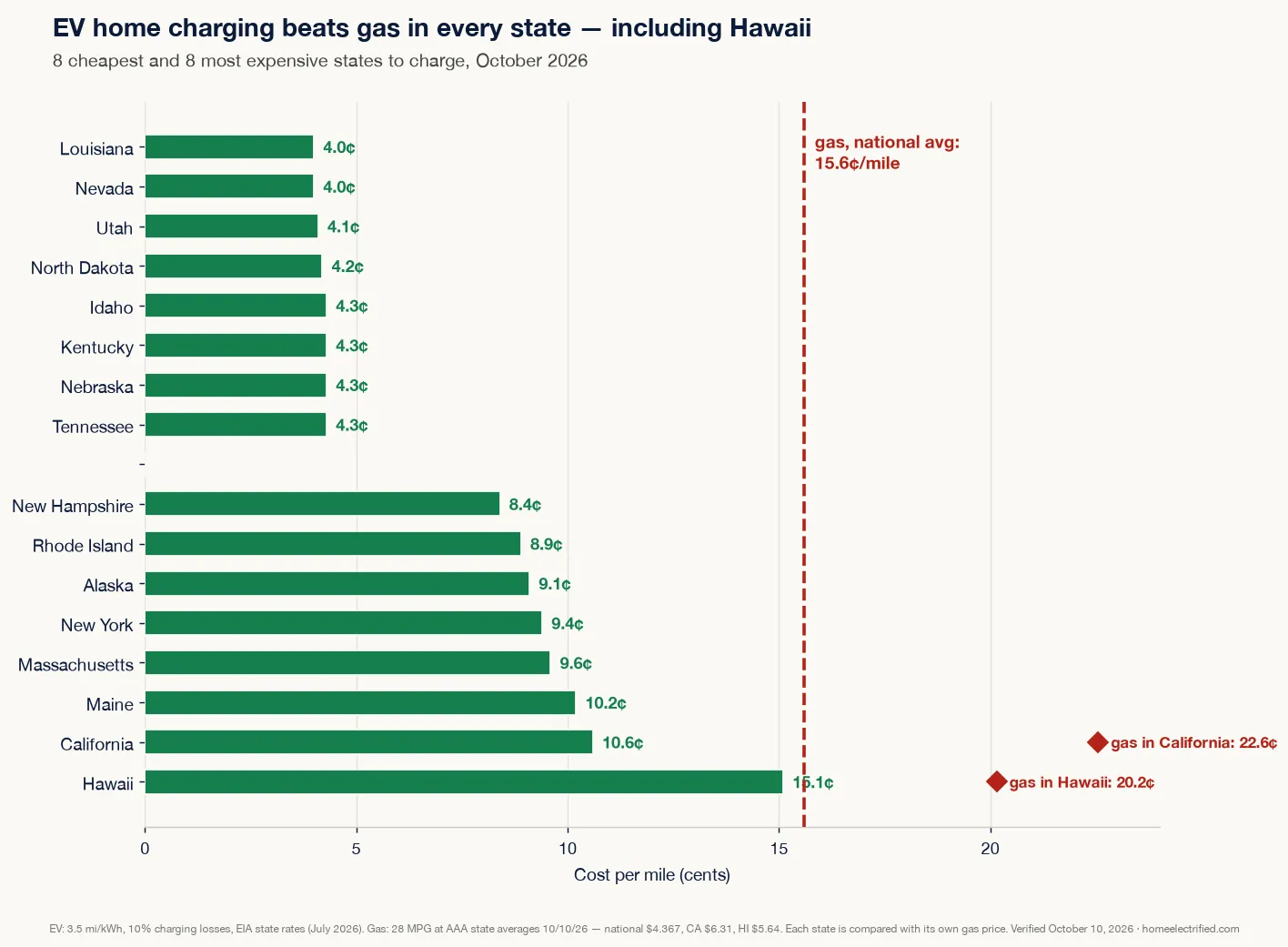
Cost per mile assumes a typical 3.5 mi/kWh EV with 10% charging losses; full charge assumes a 75 kWh battery; annual cost assumes 13,500 miles/year (the average U.S. driver).
| State | Electricity rate | Cost per mile | Full charge (75 kWh) | Annual charging cost |
|---|---|---|---|---|
| Alabama | 16.40¢ | 5.2¢ | $13.53 | $696 |
| Alaska | 28.83¢ | 9.1¢ | $23.78 | $1,223 |
| Arizona | 15.38¢ | 4.8¢ | $12.69 | $653 |
| Arkansas | 14.33¢ | 4.5¢ | $11.82 | $608 |
| California | 33.61¢ | 10.6¢ | $27.73 | $1,426 |
| Colorado | 17.00¢ | 5.3¢ | $14.03 | $721 |
| Connecticut | 24.16¢ | 7.6¢ | $19.93 | $1,025 |
| Delaware | 18.48¢ | 5.8¢ | $15.25 | $784 |
| District of Columbia | 25.21¢ | 7.9¢ | $20.80 | $1,070 |
| Florida | 15.03¢ | 4.7¢ | $12.40 | $638 |
| Georgia | 16.27¢ | 5.1¢ | $13.42 | $690 |
| Hawaii | 48.00¢ | 15.1¢ | $39.60 | $2,037 |
| Idaho | 13.73¢ | 4.3¢ | $11.33 | $583 |
| Illinois | 19.22¢ | 6.0¢ | $15.86 | $815 |
| Indiana | 16.73¢ | 5.3¢ | $13.80 | $710 |
| Iowa | 15.99¢ | 5.0¢ | $13.19 | $678 |
| Kansas | 15.27¢ | 4.8¢ | $12.60 | $648 |
| Kentucky | 13.81¢ | 4.3¢ | $11.39 | $586 |
| Louisiana | 12.72¢ | 4.0¢ | $10.49 | $540 |
| Maine | 32.41¢ | 10.2¢ | $26.74 | $1,375 |
| Maryland | 21.41¢ | 6.7¢ | $17.66 | $908 |
| Massachusetts | 30.49¢ | 9.6¢ | $25.15 | $1,294 |
| Michigan | 23.05¢ | 7.2¢ | $19.02 | $978 |
| Minnesota | 17.45¢ | 5.5¢ | $14.40 | $740 |
| Mississippi | 14.54¢ | 4.6¢ | $12.00 | $617 |
| Missouri | 16.09¢ | 5.1¢ | $13.27 | $683 |
| Montana | 14.99¢ | 4.7¢ | $12.37 | $636 |
| Nebraska | 13.78¢ | 4.3¢ | $11.37 | $585 |
| Nevada | 12.77¢ | 4.0¢ | $10.54 | $542 |
| New Hampshire | 26.60¢ | 8.4¢ | $21.95 | $1,129 |
| New Jersey | 25.19¢ | 7.9¢ | $20.78 | $1,069 |
| New Mexico | 16.09¢ | 5.1¢ | $13.27 | $683 |
| New York | 29.90¢ | 9.4¢ | $24.67 | $1,269 |
| North Carolina | 15.16¢ | 4.8¢ | $12.51 | $643 |
| North Dakota | 13.41¢ | 4.2¢ | $11.06 | $569 |
| Ohio | 19.45¢ | 6.1¢ | $16.05 | $825 |
| Oklahoma | 14.35¢ | 4.5¢ | $11.84 | $609 |
| Oregon | 15.97¢ | 5.0¢ | $13.18 | $678 |
| Pennsylvania | 21.72¢ | 6.8¢ | $17.92 | $922 |
| Rhode Island | 28.29¢ | 8.9¢ | $23.34 | $1,200 |
| South Carolina | 15.47¢ | 4.9¢ | $12.76 | $656 |
| South Dakota | 15.37¢ | 4.8¢ | $12.68 | $652 |
| Tennessee | 13.71¢ | 4.3¢ | $11.31 | $582 |
| Texas | 15.88¢ | 5.0¢ | $13.10 | $674 |
| Utah | 13.12¢ | 4.1¢ | $10.82 | $557 |
| Vermont | 23.75¢ | 7.5¢ | $19.59 | $1,008 |
| Virginia | 17.55¢ | 5.5¢ | $14.48 | $745 |
| Washington | 14.71¢ | 4.6¢ | $12.14 | $624 |
| West Virginia | 15.78¢ | 5.0¢ | $13.02 | $670 |
| Wisconsin | 19.06¢ | 6.0¢ | $15.72 | $809 |
| Wyoming | 14.36¢ | 4.5¢ | $11.85 | $609 |
| U.S. Average | 18.31¢ | 5.8¢ | $15.11 | $777 |
Cheapest states to charge: Louisiana and Nevada (4.0¢/mile), Utah (4.1¢), North Dakota (4.2¢), Tennessee, Idaho, Nebraska and Kentucky (4.3¢). Most expensive: Hawaii (15.1¢/mile), California (10.6¢), Maine (10.2¢) — and every one of them still beats gas locally. Even in Hawaii, where regular averages $5.64/gal (20.2¢/mile, AAA October 10, 2026), home charging costs 15.1¢/mile, saving about $684 a year.
Level 1 vs Level 2: does the charger change the cost?
The electricity cost is nearly the same — what changes is speed and convenience:
- Level 1 (standard 120V outlet): no install cost, but adds only ~3–5 miles of range per hour. Slightly higher losses. Fine for short commutes.
- Level 2 (240V, hardwired or plug): adds ~25–40 miles of range per hour; a full overnight charge is easy. This is what most EV owners install.
What a Level 2 installation costs in 2026
Most U.S. homeowners pay $800–$3,000 plus $100–$800 for the charger for a professionally installed Level 2 charger:
| Scenario | Typical cost |
|---|---|
| Basic: 40A unit, short wire run, spare panel capacity | $900–$1,300 |
| Mid-range: 40–50A unit, 25–40 ft run | $1,400–$2,000 |
| Complex: 48–60A unit, panel upgrade or trenching | $2,000–$3,500 |
At the national-average savings of ~$1,329/year vs gas, a $1,600 mid-range install pays for itself in about 14 months — the calculator above computes your exact payback. For the full component-by-component breakdown, see our Level 2 charger installation cost guide. If your panel can’t take a new 240V circuit, see what an electrical panel upgrade costs: adding one pushes that 14-month payback to about 34 months at U.S. averages.
The federal charger tax credit is gone
The federal Section 30C credit — 30% of hardware + installation up to $1,000 — expired June 30, 2026 under the One Big Beautiful Bill Act, and no extension is pending. Chargers had to be operational by that date to qualify. If you installed before the deadline, you can still claim it on your 2026 return.
Utility rebates are what’s left, and they’re worth more than most people expect: the programs we verified in August 2026 pay $700–$1,000 on standard tiers and $1,500–$5,000 for income-qualified customers. They also move fast — ComEd’s Illinois program closed to new applications this year. See which EV charger rebates are still open, re-verified monthly against each utility’s own page.
Home vs public charging
Home charging is the cheap option. DC fast charging typically runs 40–60¢/kWh — three times the average home rate, and at that price a “full tank” of electrons can approach gas cost per mile. The rule of thumb: charge at home for daily driving, use fast charging for road trips. If you can’t charge at home (apartment, street parking), your economics change substantially and are worth a separate calculation.
Methodology & sources
Electricity and gas figures re-verified October 10, 2026 (charger install ranges and rebate programs carry their own dates):
- Electricity rates: U.S. Energy Information Administration, Electric Power Monthly, Table 5.6.A (July 2026, the latest state-level data), retrieved directly from EIA on October 10, 2026. U.S. average: 18.31¢/kWh residential (July 2025: 17.45¢).
- Gas price: AAA national average, $4.367/gallon regular, and AAA state averages for every state (both retrieved October 10, 2026). State comparisons use each state’s own gas price — e.g. Hawaii $5.64/gal, California $6.32/gal, Texas $3.84/gal — not the national average.
- Charger installation costs: cross-referenced 2026 ranges from EnergySage, Qmerit, and independent installer guides.
- 30C credit expiration: confirmed against Rewiring America, Plug In America, and the DOE Alternative Fuels Data Center (post-OBBBA guidance).
- Assumptions: 3.5 mi/kWh EV efficiency (typical for current mid-size EVs), 28 MPG comparison car (EPA real-world average for new gas vehicles), 13,500 miles/year (FHWA average driver), 10% Level 2 charging losses (typical range 5–15%).
Rates change. This page is re-verified on a scheduled basis; the “verified” date above always reflects the most recent check.
Frequently asked questions
How much does it cost to fully charge an electric car at home?
About $15.11 for a typical 75 kWh battery at the U.S. average residential rate of 18.31¢/kWh (EIA, July 2026 data), including ~10% charging losses. State costs range from ~$10.50 (Louisiana) to ~$40 (Hawaii).
Is charging an EV at home cheaper than gas?
Yes, in every state — checked state by state against each state's own gas price. Home charging costs ~5.8¢ per mile versus ~15.6¢ per mile for a 28-MPG car at the national average gas price. The gap narrows where electricity is expensive but never closes: in Hawaii, charging runs 15.1¢/mile against 20.2¢/mile for gas.
How much does home charging add to your electric bill?
For an average driver (13,500 miles/year), about $65/month at the U.S. average rate — from roughly $45/month in the cheapest states (Louisiana, Nevada) to $170/month in Hawaii.
Does the EV charger tax credit still exist in 2026?
No — the federal Section 30C credit (30% up to $1,000) expired June 30, 2026, and no extension is pending. Installations completed before that date can still be claimed. State and utility rebates remain available in many areas.
How much does it cost to install a Level 2 home charger?
Typically $800–$3,000 plus $100–$800 for the charger: about $900–$1,300 for a simple installation with spare panel capacity, up to $2,000–$3,500 if you need a panel upgrade or a long wire run.