Quick answer: The federal heat pump tax credits (Section 25C and 25D) both expired December 31, 2025 — 2026 installs don’t qualify. The money now comes from IRA-funded HEAR rebates (up to $8,000 toward a heat pump if you income-qualify, part of up to $14,000 total) plus state and utility rebates. The catches: HEAR is income-based, funds are limited (Colorado’s single-family program is closed and Georgia’s is paused), and since September 1, 2026, new HEAR reservations can’t pay to replace a gas, oil or propane system — you can add a heat pump and keep the existing system, with insulation first. The reliable way to find what you can still get is the DSIRE database (dsireusa.org) and your utility’s website.
Last verified: October 11, 2026. Federal credit status confirmed against ENERGY STAR and the DOE; HEAR/HEEHRA rules from DOE Program Notice 26-2 and DOE’s September 2026 FAQ; state status from state energy offices. Programs change fast — always confirm current availability. Sources in the methodology section.
The federal tax credits are gone — both of them
This is the big 2026 change, and many pages haven’t caught up. Under the One Big Beautiful Bill Act:
- Section 25C (air-source heat pumps, up to $2,000) — expired for systems placed in service after December 31, 2025.
- Section 25D (geothermal heat pumps, 30%) — also expired after December 31, 2025, despite older guides that still claim it runs to 2032. We confirmed this directly against ENERGY STAR.
Only systems installed and operational by December 31, 2025 qualify (claim on IRS Form 5695 with your 2025 return). For 2026, the federal tax credit path is closed — but the rebate path is open.
What replaced them: HEAR and HOMES rebates
The IRA created two rebate programs, funded federally and run by each state’s energy office. Unlike the expired tax credits, these survived — and they’re point-of-sale rebates (money off at purchase), not something you wait for at tax time.
HEAR (Home Electrification & Appliance Rebates)
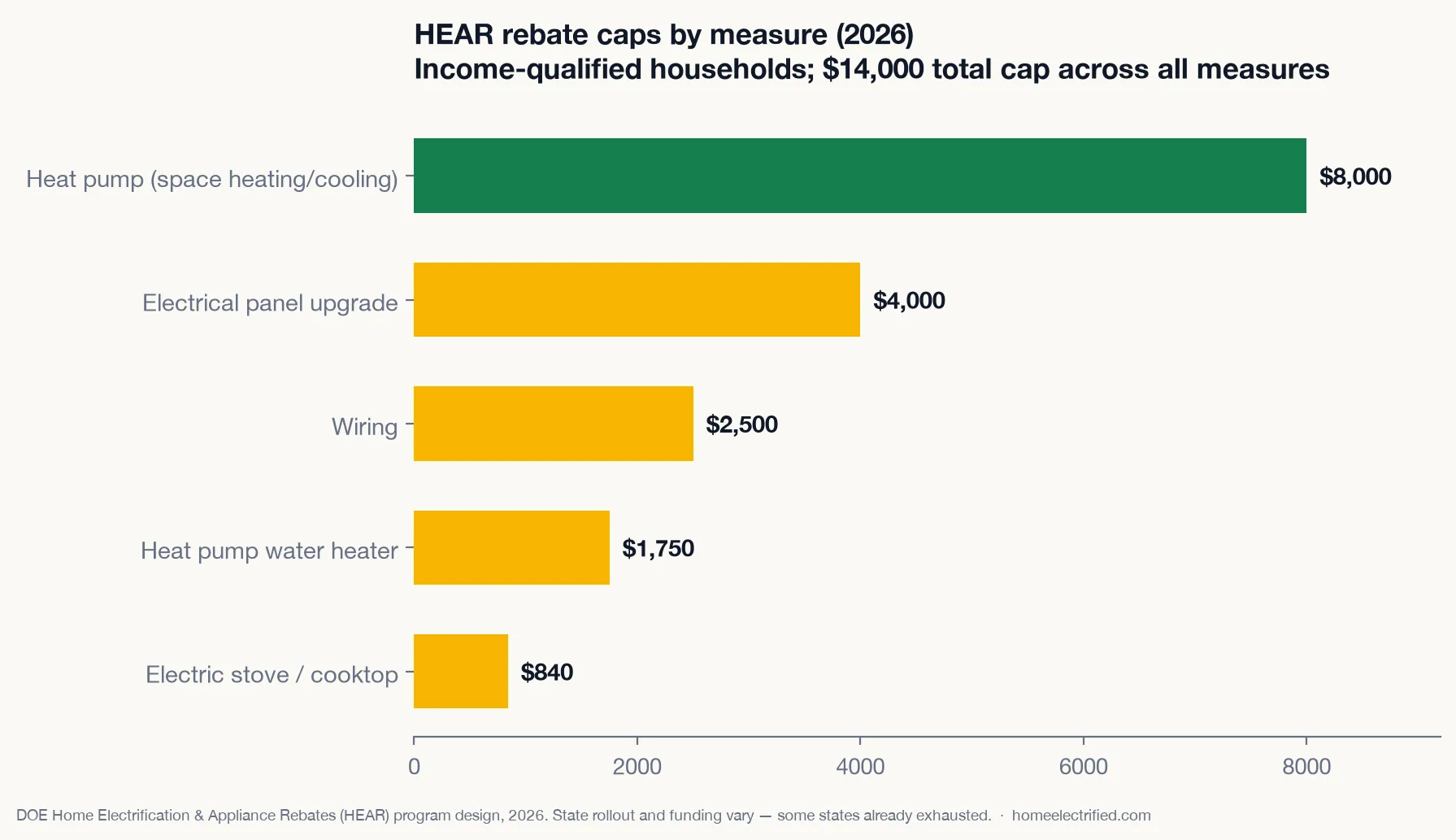
Originally called HEEHRA. Income-qualified households can get:
| Measure | Maximum rebate |
|---|---|
| Heat pump (space heating/cooling) | $8,000 |
| Heat pump water heater | $1,750 |
| Electric stove / cooktop | $840 |
| Electrical panel upgrade | $4,000 |
| Wiring | $2,500 |
| Total cap across all measures | $14,000 |
Income tiers (of area median income, AMI):
- Below 80% AMI: up to 100% of project cost covered (up to the caps above)
- 80–150% AMI: up to 50% of project cost covered
- Above 150% AMI: not eligible for HEAR (use state/utility rebates instead)
⚠️ New rule since September 1, 2026: no rebate for replacing gas, oil or propane equipment. DOE Program Notice 26-2 (effective May 29, 2026; required for all new reservations from September 1, 2026) removed fuel-switching from HEAR — now officially the High-Efficiency Electric Home Rebate (HEEHR) program. For new reservations:
- Replacing a gas, oil or propane furnace, boiler or water heater with an electric one is no longer eligible. Rebates cover upgrading existing electric equipment to more efficient electric equipment, plus new construction.
- You can add a heat pump and keep your existing system. DOE now allows the fossil-fuel system to stay in place, even if the heat pump won’t be the main heat source (DOE Home Energy Rebates FAQ, September 2026).
- Insulation and air sealing come first, unless your home already meets your state’s DOE-approved level.
- Reservations approved before September 1, 2026 can still be completed under the old rules.
The rebate caps above are unchanged; what changed is which projects qualify. States can also narrow eligibility further, so check your state program’s current rules.
HOMES (Home Efficiency Rebates)
The companion program rewards whole-home energy savings rather than specific appliances, and isn’t income-restricted the same way — larger rebates for bigger measured/modeled energy reductions. Good if a heat pump is part of a broader efficiency project.
⚠️ These funds are limited — and some states are out. Each state got a fixed federal allocation. Colorado’s single-family HEAR program is closed — its official dashboard shows $0 remaining in both regions (updated August 3, 2026). Georgia paused HEAR on August 14, 2026; per its program updates page it is reopening in October 2026 with limited funding, for single-family electrical wiring and panel upgrades only, and only alongside an eligible Home Efficiency Rebates (HER) project. California’s HEEHRA single-family rebates were fully reserved as of February 2026, with new requests waitlisted. Availability and timing vary by state — check your state’s status before you count on it.
The durable way to find your rebate (works in any year)
Programs open, close, and exhaust their budgets constantly, so the reliable skill is knowing where to look:
- DSIRE (dsireusa.org) — search your ZIP for every federal, state, utility, and local program. Best starting point.
- Your state energy office — it administers HEAR/HOMES and lists current status and how to apply.
- Your electric (and gas) utility — utility heat pump rebates ($300–$2,000+) aren’t income-restricted and stack with other programs. This is the path for higher-income households who don’t qualify for HEAR.
Put it in context
A whole-home air-source heat pump costs $6,000–$13,000 installed. A HEAR rebate can cover most or all of that for a qualifying household — if the project fits the post-September 2026 rules (no replacing gas, oil or propane equipment; insulation first); a utility rebate can take a few hundred to a couple thousand off for everyone else. And whether the switch lowers your running cost depends on your state — see heat pump vs gas furnace running cost and its calculator.
Methodology & sources
Verified October 11, 2026 (first published July 6, 2026):
- Federal credit expiration (25C and 25D, December 31, 2025): confirmed against ENERGY STAR’s tax-credit pages and the DOE (post-One Big Beautiful Bill Act guidance). Third-party claims that 25D geothermal continues to 2032 are outdated.
- HEAR/HOMES amounts and structure: DOE Home Energy Rebates program design (HEAR up to $8,000 for heat pumps, $14,000 total; AMI-based tiers) and state energy-office implementations. Program names: HEEHRA (original IRA name) = HEAR = HEEHR (DOE’s current name).
- Fuel-switching, add-on heat pump and insulation-first rules: DOE Home Energy Rebates Program Notice 26-2 (effective May 29, 2026; new reservations must comply from September 1, 2026) and the DOE Home Energy Rebates FAQ, updated September 2026, both read October 11, 2026.
- Colorado closed: Colorado Energy Office HEAR dashboard ($0 remaining in both regions; last updated August 3, 2026), read October 11, 2026.
- Georgia paused: Georgia Home Energy Rebates — HEAR program updates (paused since August 14, 2026; reopening October 2026 for single-family wiring and panel upgrades tied to an HER project), read October 11, 2026.
- California fully-reserved status: California Energy Commission / TECH Clean California HEEHRA reporting, as of February 2026 (not re-checked on an official page in October).
- DSIRE (dsireusa.org): authoritative address-level program database.
- Rebate amounts, eligibility, and availability vary by state and change frequently; confirm current terms with your state program and utility before purchasing.
Incentives are the most volatile data on this site. This page is re-verified on a schedule; the “verified” date reflects the latest check. Treat a program’s official current terms as correct over this page.
Frequently asked questions
Is there a federal heat pump tax credit in 2026?
No. Both the Section 25C air-source heat pump credit (up to $2,000) and the Section 25D geothermal credit (30%) expired for systems placed in service after December 31, 2025. Only installs completed by that date can be claimed. Many websites still list these credits as available — they are out of date.
What is the HEAR heat pump rebate?
HEAR (Home Electrification and Appliance Rebates, originally called HEEHRA) is an IRA-funded, state-administered program that gives income-qualified households up to $8,000 toward a heat pump — part of up to $14,000 total across heat pumps, water heaters, stoves, and electrical panels. It's a point-of-sale rebate, not a tax credit, and it's rolling out state by state. Since September 1, 2026, DOE rules (Program Notice 26-2) bar new reservations from paying to replace gas, oil or propane equipment; you can add a heat pump and keep the existing system, and insulation and air sealing come first.
Do I qualify for the HEAR heat pump rebate?
HEAR is income-based. Households below 80% of area median income (AMI) typically get 100% of project costs covered up to the caps; those at 80–150% AMI get about 50%; above 150% AMI are not eligible for HEAR. Check your state's program for exact thresholds — and whether funds are still available. Under DOE Program Notice 26-2, new reservations made since September 1, 2026 also can't fund replacing gas, oil or propane equipment: the heat pump can be added alongside your existing system, and your state may require insulation and air sealing first.
Can I still get a heat pump rebate if I don't qualify for HEAR?
Yes — through state and utility rebates, which aren't income-restricted the same way. Many utilities offer $300–$2,000+ toward a heat pump. Search the DSIRE database (dsireusa.org) by ZIP code and check your utility's website to find them.
Are HEAR rebate funds running out?
In some states, yes. Colorado's single-family HEAR funds show $0 remaining and the program closed in both regions (Colorado Energy Office dashboard, updated August 3, 2026). Georgia paused HEAR on August 14, 2026; it is reopening in October 2026 with limited funding, for single-family electrical wiring and panel upgrades only, and only alongside an eligible Home Efficiency Rebates project. California's HEEHRA single-family rebates were fully reserved as of February 2026, with new requests waitlisted. These programs have fixed budgets, so availability depends on your state's status and timing — confirm current availability before you buy.