Quick answer: Yes — modern cold-climate heat pumps keep heating effectively down to about -15°F, and the real-world data backs it up: an Efficiency Maine study found 7 of 10 homes needed essentially no backup heat, with heat pumps carrying at least 80% of the heating load even at -5°F. Whether one is worth it for you depends less on the cold and more on what you’re replacing (electric resistance, oil, and propane are slam-dunk wins; cheap natural gas is closer) and your local electricity price.
Last verified: October 11, 2026 for rebate rules; July 6, 2026 for performance and adoption data. Performance data from NEEP and Efficiency Maine; adoption figures from the State of Maine. Sources in the methodology section.
Do heat pumps actually work in the cold?
This is the myth that won’t die — that heat pumps “stop working” when it gets cold. That was true of older units; it isn’t true of modern cold-climate models.
Today’s cold-climate heat pumps use variable-speed inverter compressors that ramp output up and down and pull usable heat from very cold outdoor air. The industry benchmark is the NEEP ccASHP specification (Northeast Energy Efficiency Partnerships): to qualify, a model is tested for strong heating capacity and efficiency at 5°F and below, and quality units keep working down to about -15°F. NEEP publishes a free, searchable list of certified models at ashp.neep.org.
The proof: an entire cold state went all-in
You don’t have to take the spec sheet’s word for it — Maine ran the experiment at scale:
- Maine hit its goal of 100,000 new heat pumps in 2023, two years ahead of schedule, then set a new target of 175,000 more by 2027 (275,000 total).
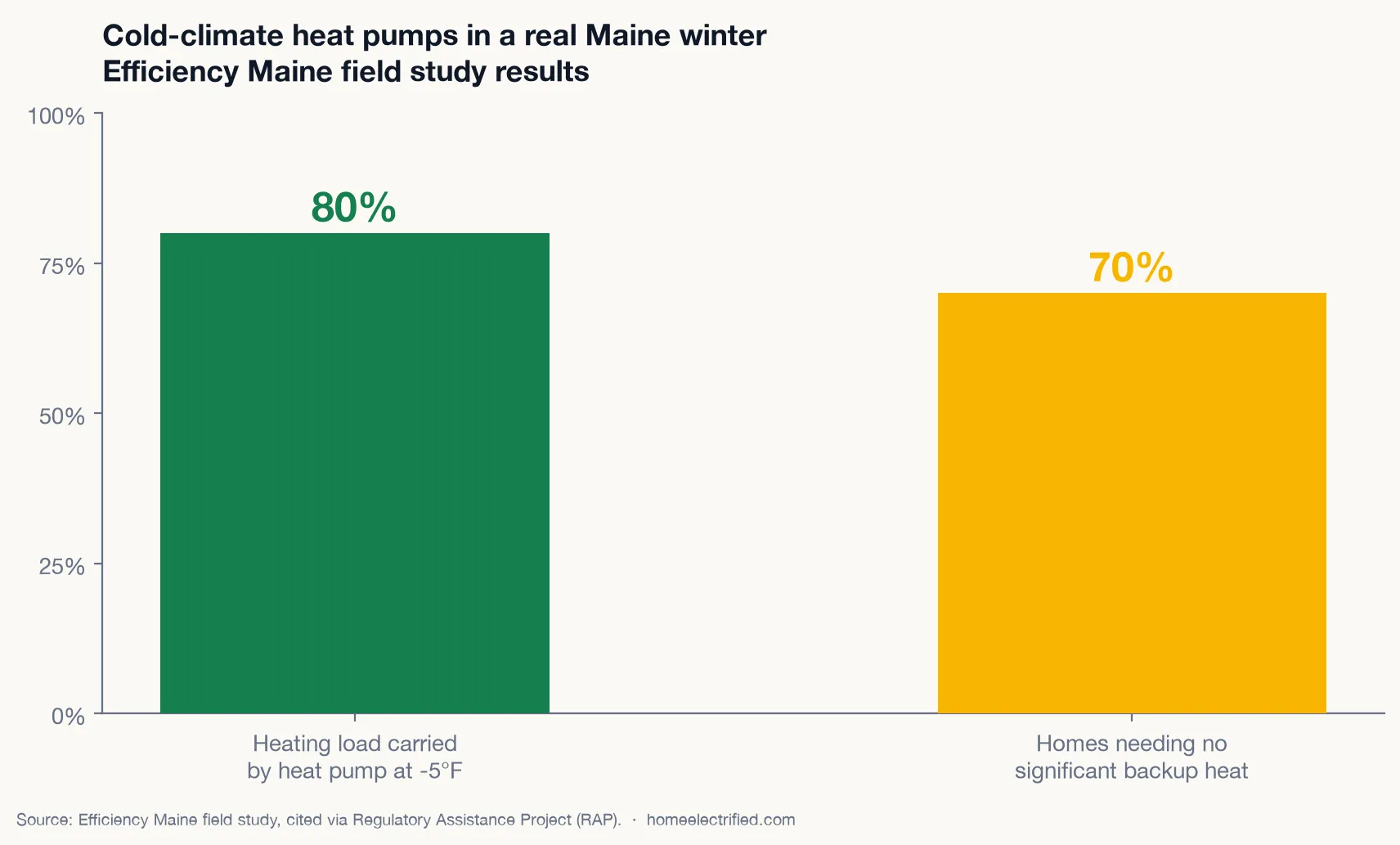
- In an Efficiency Maine field study, heat pumps delivered at least 80% of the home’s heating load even at -5°F, and 7 of 10 homes used essentially no supplemental heating through the winter.
If heat pumps can carry Maine winters as the primary heat source, they can carry Michigan, Minnesota, Ohio, and the rest of the cold belt.
But is it worth it for you? It comes down to what you’re replacing
“Works in the cold” and “saves you money” are different questions. The running-cost answer depends almost entirely on the fuel you’re switching away from:
| You currently heat with… | Is a heat pump worth it on running cost? |
|---|---|
| Electric resistance (baseboard, electric furnace) | Yes — big win. A heat pump delivers the same heat for roughly one-third the electricity. |
| Heating oil | Yes. Oil is expensive per BTU; a heat pump almost always beats it. |
| Propane | Yes. Similar to oil — propane is costly, heat pump wins in nearly all states. |
| Cheap natural gas | It’s closer. Depends on your electricity price — a heat pump wins in low-electricity states, gas may edge it in high-electricity ones. |
For the natural-gas case specifically, plug your state and prices into our heat pump vs gas furnace running-cost calculator — it shows your exact break-even. And remember a heat pump also replaces your air conditioner, so you’re buying one system instead of two.
What to look for in a cold climate
- NEEP-certified (ccASHP) model — don’t let anyone install a standard heat pump for a cold winter. Check ashp.neep.org.
- Proper sizing to your design temperature — via a Manual J load calculation, not square footage. Oversizing hurts efficiency; undersizing leaves you cold on the worst nights.
- A backup plan for the coldest hours — electric resistance strips, or keep your existing furnace as a dual-fuel system that switches over below a set temperature. Many homes rarely use it, but it’s cheap insurance.
- Higher HSPF2 — the seasonal heating-efficiency rating; higher means lower winter bills.
Cost and rebates
A cold-climate air-source system costs about the same as any whole-home heat pump — $6,000–$13,000 installed. The federal tax credits expired at the end of 2025, but cold states tend to have the strongest utility and state rebates (and income-qualified HEAR rebates up to $8,000 — though since September 1, 2026, new HEAR reservations can’t fund replacing an oil, propane or gas system; you can add a heat pump and keep it, with insulation first, per DOE Program Notice 26-2) — see heat pump rebates in 2026.
Methodology & sources
Verified July 6, 2026:
- Cold-climate performance & NEEP ccASHP spec: Northeast Energy Efficiency Partnerships (neep.org, ashp.neep.org) — models tested for capacity at 5°F and below, effective operation to ~-15°F.
- Maine field performance: Efficiency Maine study — heat pumps provided ≥80% of heating load at -5°F; 7 of 10 homes used no significant supplemental heat.
- Maine adoption milestones: State of Maine / Office of the Governor — 100,000 heat pumps installed by 2023 (two years early); new 175,000-by-2027 target.
- Running-cost logic and break-even: see our heat pump vs gas furnace running-cost analysis (EIA electricity July 2026, EIA gas $1.56/therm March 2026, seasonal COP 3.0; re-checked October 10, 2026).
- Whether a heat pump saves you money depends on your climate, equipment COP, and local electricity/fuel prices; get a Manual J calculation and local quotes.
This page is re-verified on a schedule; the “verified” date reflects the latest check.
Frequently asked questions
Do heat pumps actually work in cold weather?
Yes. Modern cold-climate heat pumps (NEEP-certified ccASHP models) use variable-speed inverter compressors that keep heating effectively down to about -15°F. In an Efficiency Maine study, heat pumps supplied at least 80% of the heating load even at -5°F outdoor temperatures, and 7 of 10 homes used essentially no backup heat.
Is a heat pump worth it in a cold state like Michigan or Minnesota?
It can be, especially if you're replacing electric resistance, oil, or propane heat — a heat pump uses far less energy for the same warmth. Against cheap natural gas it's closer and depends on your electricity price. Choose a cold-climate (NEEP-certified) model sized for your winter design temperature.
Do I need backup heat with a heat pump in a cold climate?
Often a properly sized cold-climate heat pump can be the sole heat source, but many installs include backup — electric resistance strips or keeping an existing furnace as a 'dual-fuel' system — for the coldest hours and peace of mind. In the Maine study, 7 of 10 homes rarely used any.
What is a cold-climate heat pump?
One certified to the NEEP ccASHP specification, meaning it's tested to maintain strong heating capacity and efficiency at 5°F and below, with effective operation to about -15°F. NEEP publishes a searchable list (ashp.neep.org) of qualifying models.
Will a heat pump lower my heating bill in a cold climate?
It depends on your electricity vs. fuel prices. If you heat with electric resistance, oil, or propane, almost certainly yes. If you have cheap natural gas, it may cost slightly more to run for heat but still wins on cooling, comfort, and emissions. Use our running-cost calculator to check your break-even.