Quick answer: In 2026, a single-zone ductless mini-split costs about $2,500–$6,000 installed. Multi-zone systems scale up with each indoor head: roughly $4,500–$8,000 for two zones, $6,500–$11,000 for three, and $10,000–$15,000 for five. The biggest cost drivers are the number of zones and total capacity (BTUs). A mini-split is also a heat pump, so it both heats and cools — and at the U.S. average electricity rate it runs about 11¢ per hour to cool a 1-ton zone.
Last verified: August 2, 2026. Installed cost ranges cross-referenced from HomeGuide and Angi 2026 mini-split data; running cost computed at the U.S. average residential rate of 18.44¢/kWh (EIA, May 2026). Sources in the methodology section.
Ductless mini-split cost by number of zones
A “zone” is one indoor head — the wall-mounted (or ceiling/floor) unit that conditions a space. One outdoor compressor can feed one head (single-zone) or several (multi-zone). The number of zones is the single biggest thing that moves the price:
| Zones | Typical installed cost (2026) | Typical use |
|---|---|---|
| 1 (single-zone) | $2,500–$6,000 | One room, an addition, a garage, or a problem space |
| 2 | $4,500–$8,000 | Two bedrooms, or a main floor split into two areas |
| 3 | $6,500–$11,000 | A small home or a floor with three distinct spaces |
| 5 | $10,000–$15,000 | Whole-home comfort without ductwork |
| 8 | $18,000–$20,000+ | Large or multi-story homes, whole-house coverage |
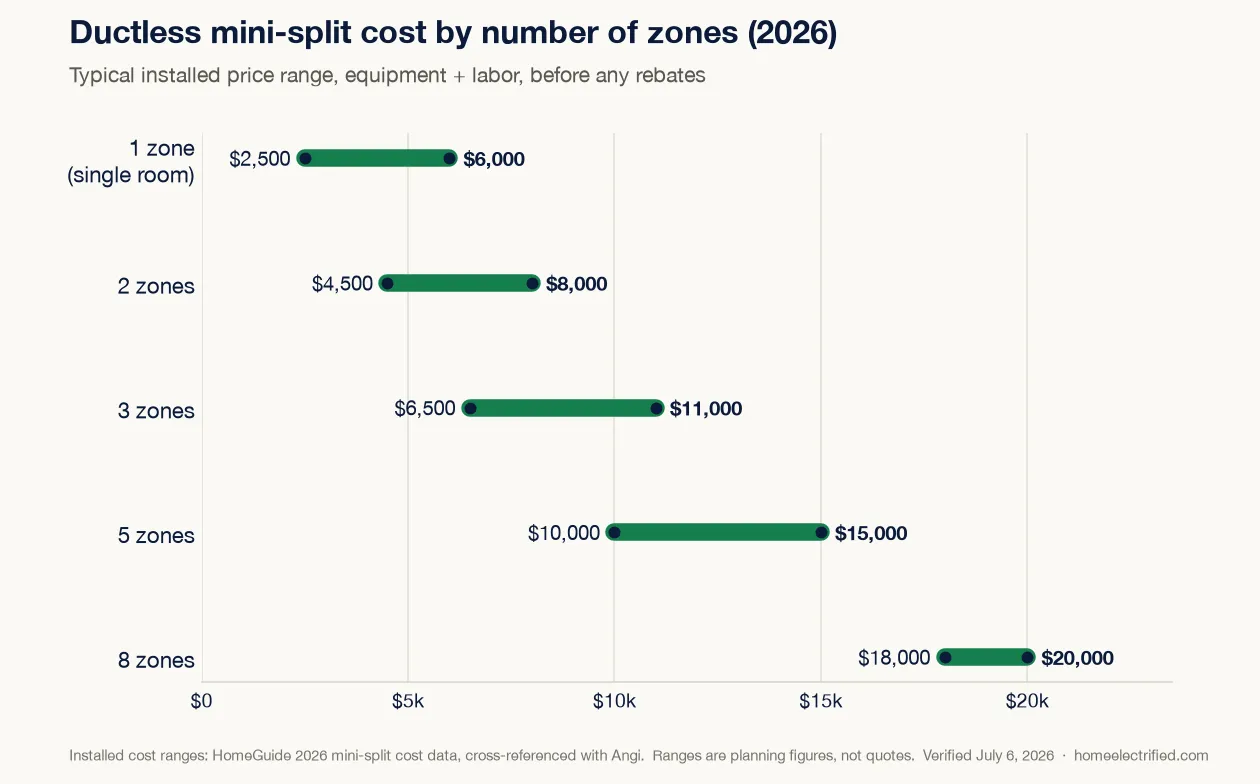
Notice the cost doesn’t fall much per zone as you add heads — each one needs its own indoor unit, refrigerant line set, condensate drain, and mounting labor. Practically, budget roughly $2,000–$4,000 for each additional zone after the first.
Cost by size (BTU / tons)
For a single-zone system, capacity is the other main lever. Mini-splits are sized in BTUs (or “tons” — 12,000 BTU = 1 ton of capacity, a measure of output, not weight). Bigger space, more BTUs, higher cost:
| Capacity | Room size (rough) | Installed cost (2026) |
|---|---|---|
| 9,000 BTU (0.75 ton) | up to ~350 sq ft | $3,000–$4,200 |
| 12,000 BTU (1 ton) | ~400–550 sq ft | $3,500–$5,000 |
| 18,000 BTU (1.5 ton) | ~700–1,000 sq ft | $4,500–$6,500 |
| 24,000 BTU (2 ton) | ~1,000–1,500 sq ft | $6,000–$8,000 |
| 36,000 BTU (3 ton) | ~1,500 sq ft+ | $8,000–$11,000 |
Sizing should come from a Manual J load calculation by the installer, not square footage alone — an oversized mini-split short-cycles, dehumidifies poorly, and costs more than it needs to.
What drives the price
Beyond zones and size, five things move a mini-split quote:
- Number of indoor heads. Each zone adds equipment and labor, as above.
- Line-set length and routing. A short, straight run from the indoor head to the outdoor unit is cheap; long runs, multi-story routing, or hiding lines inside finished walls cost more.
- Efficiency (SEER2 / HSPF2). An entry-level unit is cheaper upfront; a premium high-SEER2 inverter model costs more but cuts running cost — worth it in a space you run a lot.
- Electrical work. A new dedicated circuit or a service upgrade adds cost. Mini-splits draw less than many electric systems, but the circuit still has to exist.
- Cold-climate rating. Models built to hold capacity below freezing cost more but are what make a mini-split viable for heating in northern states — see is a heat pump worth it in a cold climate.
How much does a mini-split cost to run?
Because a ductless mini-split is a heat pump, running cost depends on how hard it works, but the per-hour math is easy to check. At the U.S. average residential rate of 18.44¢/kWh, using an efficient inverter unit (SEER2 ~20 cooling, heating COP ~3):
| Size | Cooling (per hour) | Heating (per hour) |
|---|---|---|
| 9,000 BTU (0.75 ton) | ~$0.08 | ~$0.16 |
| 12,000 BTU (1 ton) | ~$0.11 | ~$0.22 |
| 18,000 BTU (1.5 ton) | ~$0.17 | ~$0.32 |
| 24,000 BTU (2 ton) | ~$0.22 | ~$0.43 |
The cooling math for a 1-ton unit: 12,000 BTU/hr ÷ SEER2 20 = 600 watts = 0.6 kW, and 0.6 kW × 18.44¢ ≈ 11¢ per hour at full load. Heating pushes about three units of heat per unit of electricity (COP ~3), so a 1-ton unit draws ~1.17 kW ≈ 22¢ per hour.
In practice, one zone cooling a bedroom ~8 hours a day works out to roughly $25–$30 a month; the same zone heating ~10 hours a day in winter is roughly $60–$70 a month at full-load equivalent. Real bills are usually lower, because inverter compressors ramp down and rarely run at full power once the room is at temperature. Your actual cost scales with your local electricity rate — see EV home charging cost for the full 50-state rate table we use.
Is a mini-split cheaper than central air?
It depends on your house:
- You already have ductwork: a central ducted heat pump or AC is usually the cheaper way to condition the whole home for the same coverage. A multi-zone mini-split covering every room can cost as much as or more than central.
- You have no ducts (older homes, radiators, additions, converted spaces): a mini-split is almost always cheaper than adding ductwork and a central system.
- You only need part of the house — one hot bedroom, a garage gym, a sunroom, a new addition: a single-zone mini-split is the clear winner, and central air can’t easily reach those spaces anyway.
For the whole-home comparison across types, see heat pump cost by type, where central ducted air-source runs $6,000–$13,000.
Rebates and incentives in 2026
A ductless mini-split heat pump is eligible for the same 2026 programs as any heat pump — but the federal picture changed. Under the One Big Beautiful Bill Act, the Section 25C credit (up to $2,000) expired for systems placed in service after December 31, 2025. For 2026 installs, the savings now come from:
- IRA-funded HEAR rebates — up to $8,000 toward a heat pump for income-qualified households, administered state by state.
- State and utility rebates, which often stack on top.
Look up what’s available at your address in the DSIRE database (dsireusa.org) and on your utility’s site. Full detail — including who qualifies and how much — is in heat pump rebates 2026.
Methodology & sources
Verified July 6, 2026:
- Installed cost by zones and size: cross-referenced from HomeGuide’s 2026 ductless mini-split cost data (by-zone: 1 zone $2,500–$6,000 through 8 zones $18,000–$20,000+; by-size: 0.75-ton $3,000–$4,200 through 3-ton $8,000–$11,000) and Angi’s 2026 mini-split guide. Angi lists lower BTU-level figures because several are equipment-leaning rather than fully installed; where the two differ we used the installed ranges. Per-zone increment (~$2,000–$4,000) derived from the step between adjacent zone counts.
- Running cost: computed at the U.S. average residential electricity rate of 18.44¢/kWh (EIA May 2026, the same figure used across this site), assuming an efficient inverter unit at SEER2 ≈ 20 (cooling) and heating COP ≈ 3. Per-hour figures are full-load equivalents; inverter modulation typically makes real-world cost lower. Formula shown in the section above.
- Incentive status: Section 25C heat pump credit expired for systems placed in service after December 31, 2025 (One Big Beautiful Bill Act); 2026 pathways are IRA HEAR rebates (up to $8,000, income-qualified) plus state/utility programs via DSIRE. Detail in heat pump rebates 2026.
- Figures are planning estimates, not quotes; get itemized local bids and insist on a Manual J sizing calculation.
Costs, electricity rates, and incentive programs change; this page is re-verified on a schedule and the “verified” date reflects the latest check.
Frequently asked questions
How much does a ductless mini-split cost in 2026?
A single-zone ductless mini-split costs about $2,500–$6,000 installed. Multi-zone systems run roughly $4,500–$8,000 for two zones, $6,500–$11,000 for three, and $10,000–$15,000 for five. Price scales with the number of indoor heads and total capacity.
How much does it cost to install a mini-split per zone?
Figure roughly $2,000–$4,000 per additional indoor zone (head) after the first, since each one needs its own wall unit, refrigerant lines, and mounting labor. A single head is cheapest per zone; costs don't drop much per zone as you add more.
How much does a mini-split cost to run?
At the U.S. average electricity rate of 18.44¢/kWh, an efficient 12,000 BTU (1-ton) mini-split costs about 11¢ per hour to cool and about 22¢ per hour to heat at full load. A single zone cooling a bedroom ~8 hours a day runs roughly $25–$30 a month; inverter units modulate down, so real bills are often lower.
Is a mini-split cheaper than central air?
For a whole house with existing ductwork, a central ducted system is usually cheaper than a multi-zone mini-split covering the same area. Mini-splits win when there are no ducts, when you only need to condition part of the home, or for additions and rooms a central system can't reach.
Are there rebates for a ductless mini-split heat pump in 2026?
The federal 25C heat pump tax credit (up to $2,000) expired for systems placed in service after December 31, 2025. In 2026 the savings come from IRA-funded HEAR rebates (up to $8,000 for income-qualified households) and state/utility programs — look yours up on DSIRE by ZIP code.