Quick answer: A heat pump is an air conditioner — one that can also run backwards to heat your home. For cooling, they use the same compressor and refrigerant cycle, so at the same SEER2 efficiency rating a heat pump and an AC cool identically and cost the exact same to run in summer. The only real differences: a heat pump costs about $1,000–$2,500 more upfront, and it also replaces your furnace. So this isn’t really “which cools better” — it’s “do you want heating from the same box, and is it worth the premium?”
Last verified: August 2, 2026. Equipment costs: Angi and NerdWallet (2026). Electricity rates: EIA Electric Power Monthly (May 2026). Efficiency standards: U.S. Department of Energy.
The one-part difference: a reversing valve
An air conditioner and a heat pump are built from the same core: a compressor, refrigerant, an outdoor coil, and an indoor coil. Both work by moving heat rather than making it. In cooling mode they’re doing the identical thing — pulling heat out of your indoor air and dumping it outside.
The heat pump adds exactly one component: a reversing valve. Flip it, and the refrigerant flows the other way, so the system pulls heat from the outdoor air (there’s usable heat in air even at freezing temperatures) and delivers it inside. That’s the whole distinction. An AC is a one-way heat mover; a heat pump is a two-way heat mover.
This is why almost every “heat pump vs AC” cost question has the same underlying answer: for cooling, there’s nothing to compare — they’re the same machine. The comparison that matters is about heating and upfront cost.
Cooling costs the same either way
Because the cooling hardware is identical, running cost in cooling mode comes down to two things you’d pick regardless of which label is on the box: the system’s SEER2 efficiency rating and your electricity price. A SEER2 16 heat pump and a SEER2 16 air conditioner draw the same watts to remove the same heat.
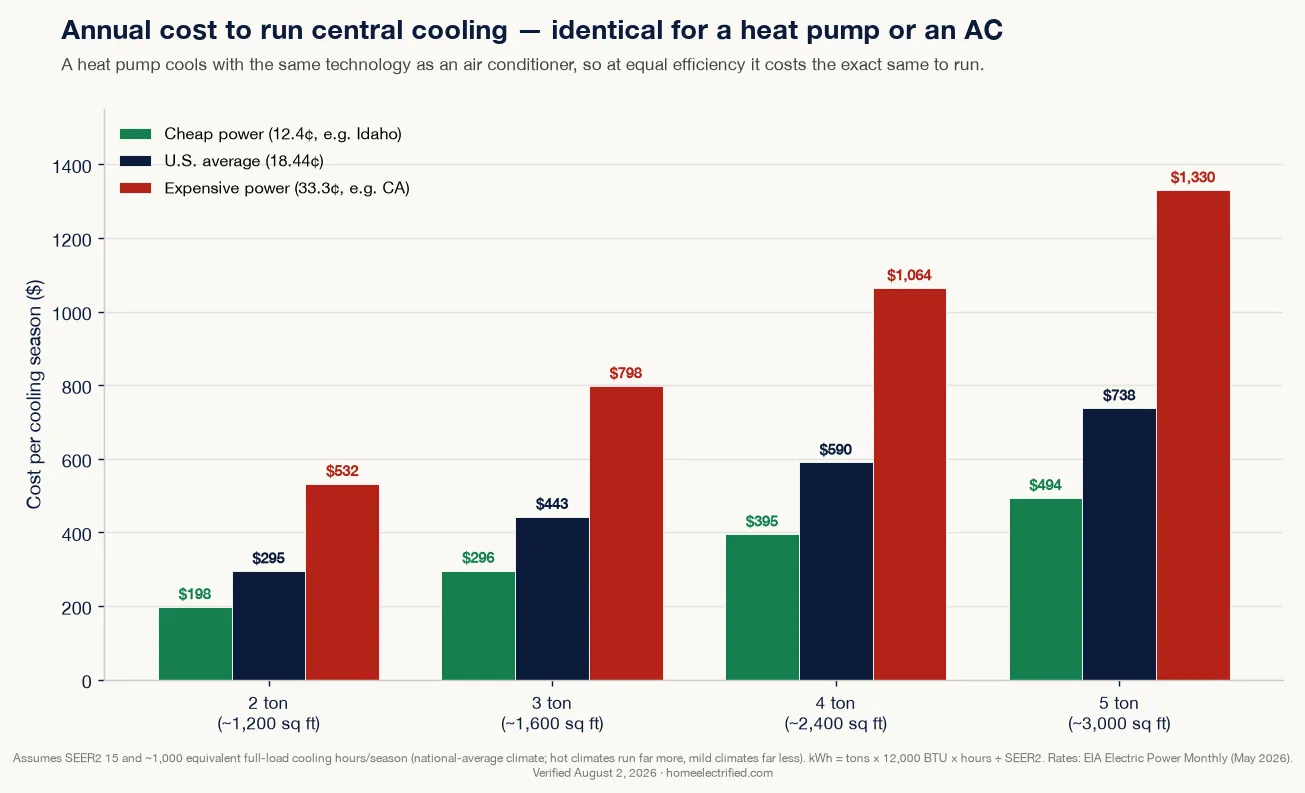
Here’s what a full cooling season costs to run at three electricity-price levels — the numbers are the same whether that outdoor unit is a heat pump or an AC:
| System size | Cooling energy | Cheap power (12.4¢) | U.S. average (18.44¢) | Expensive power (33.3¢) |
|---|---|---|---|---|
| 2 ton (~1,200 sq ft) | ~1,600 kWh | $198 | $295 | $532 |
| 3 ton (~1,600 sq ft) | ~2,400 kWh | $296 | $443 | $798 |
| 4 ton (~2,400 sq ft) | ~3,200 kWh | $395 | $590 | $1,064 |
| 5 ton (~3,000 sq ft) | ~4,000 kWh | $494 | $738 | $1,330 |
Cost per cooling season at SEER2 15 and ~1,000 equivalent full-load hours. Hot climates run 1,500–2,500+ hours (multiply up); mild climates less. Identical for a heat pump or an AC of the same efficiency.
The takeaway: if someone tells you a heat pump is cheaper (or pricier) to cool with than an AC, they’re mistaken. Two units of equal SEER2 cost the same to run. Where cost actually diverges is heating season — and that’s a comparison against your furnace, not your AC. (We break that down in heat pump vs gas furnace running cost.)
What a heat pump costs vs an AC-only system
A heat pump’s reversing valve, larger outdoor coil, and heating controls make it cost more than a cooling-only AC of the same capacity and efficiency. Based on 2026 installer pricing:
| System | Typical installed cost (2026) | What it does |
|---|---|---|
| Central air conditioner | $4,000–$12,000 (avg ~$6,000–$7,500) | Cooling only — needs a separate furnace to heat |
| Ducted air-source heat pump | $6,000–$13,000 | Cooling and heating from one system |
| The premium for the heat pump | ~$1,000–$2,500 more | Buys you the heating function |
The framing that trips people up: comparing a heat pump only to an AC makes it look like pure added expense. But an AC doesn’t heat your house. The honest comparison for most homes is heat pump vs (AC + furnace) — and there, one heat pump is frequently cheaper to buy and install than two separate systems, because you skip a second condenser, a second install, and (eventually) a second replacement.
SEER2 in 2026: pick the efficiency, not the label
Since the 2023 SEER2 transition, both AC units and heat pumps are rated on the same cooling scale, so you compare them apples-to-apples. As of 2026 the federal minimums are:
- Central AC: 14.3 SEER2 in the South/Southwest, 13.4 SEER2 in the North.
- Air-source heat pumps: 14.3 SEER2 nationally, plus a heating requirement of 7.5 HSPF2 (Heating Seasonal Performance Factor 2) that an AC doesn’t have to meet.
Higher SEER2 costs more upfront and cuts your cooling bill — but the savings are modest at typical usage. On a 3-ton system at the U.S. average rate, moving from 14.3 to 18 SEER2 trims roughly $100 a year in cooling. The efficiency choice matters far more in a hot climate that cools 2,000+ hours a year than in a mild one.
“Heat pump and furnace” — the dual-fuel setup
One autocomplete favorite is “heat pump vs AC and furnace.” Three real configurations exist:
- AC + furnace (the classic split): cooling from the AC, heating from a gas/propane/oil furnace. Two appliances.
- Heat pump alone: one system does both. Best where you’re replacing electric-resistance, oil, or propane heat, or where winters are mild-to-moderate.
- Dual-fuel (heat pump + furnace): the heat pump handles cooling and most heating; the furnace kicks in only on the coldest days when it’s cheaper than the heat pump. Common in cold-gas regions — you keep the furnace as backup instead of ripping it out.
If you’re shopping to replace a dead AC and you have a working gas furnace, options 1 and 3 are your live choices: a plain AC, or a heat pump that also lightens your furnace’s load. Modern cold-climate heat pumps hold strong efficiency well below freezing — see is a heat pump worth it in a cold climate for the field data.
So which should you get?
Because cooling is a wash, the decision is entirely about what you heat with today and whether the ~$1,000–$2,500 premium pays off. A quick matrix:
| Your current heating | Best pick when the AC dies | Why |
|---|---|---|
| Electric baseboards / resistance | Heat pump ✅ | A heat pump uses ~⅓ the electricity for the same heat — big winter savings on top of cooling |
| Oil or propane | Heat pump ✅ | Both fuels are pricey per BTU; a heat pump beats them on running cost almost everywhere |
| Old (80%) gas furnace | Heat pump (or dual-fuel) | Heat pump is cheaper to run than an old furnace in most states; keep the furnace as cold-day backup |
| Cheap natural gas, efficient furnace | AC-only, or dual-fuel | Cooling is identical; heating math is close, so the heat pump is optional, not obvious |
| You want the simplest, cheapest box today | AC-only | Lowest sticker price if you already have heating you’re keeping |
Two things that aren’t on the table but tip real decisions: a heat pump is one system to maintain and eventually replace instead of two, and in much of the country it now qualifies for state and utility rebates that a plain AC doesn’t (the federal 25C heat-pump credit expired after December 31, 2025, but state and HEAR rebates remain).
The bottom line
Stop thinking of it as “heat pump vs air conditioner.” A heat pump is an air conditioner with a heating mode bolted on. If you need cooling, you’re getting an AC either way — the question is whether, for about $1,000–$2,500 more, you also want it to heat and to (often) retire your furnace. If you heat with anything other than cheap natural gas, that premium usually pays for itself. If you have cheap gas heat you’re keeping, a plain AC is a perfectly rational buy.
Methodology & sources
Verified August 2, 2026:
- Equipment costs: Angi AC replacement guide (central AC avg ~$5,975, range $1,400–$12,500, 2026) and NerdWallet cost to install central air ($6,000–$11,500 typical, 2026); heat pump ducted range $6,000–$13,000 (cross-referenced Angi, Modernize, This Old House, Rewiring America). Heat-pump-over-AC premium ~$1,000–$2,500 (Angi, EnergySage, industry installers).
- Electricity rates: EIA Electric Power Monthly, Table 5.6.A (May 2026 state data, retrieved August 2, 2026); U.S. average 18.44¢/kWh.
- Cooling energy: derived — seasonal kWh = tons × 12,000 BTU × equivalent full-load hours ÷ SEER2. Assumes SEER2 15 and ~1,000 full-load cooling hours (national-average climate; hot climates run far more). Cross-checked against EnergySage/DOE (~2,365 kWh to cool an average home) and EIA RECS (air conditioning ≈ 19% of home electricity).
- Efficiency standards: U.S. DOE SEER2/HSPF2 minimums effective 2023–2026: central AC 14.3 SEER2 (South) / 13.4 (North); air-source heat pumps 14.3 SEER2 + 7.5 HSPF2.
- Figures are planning estimates, not quotes; your installed price depends on sizing, ductwork, and local labor, and your cooling cost on your climate and rate.
Equipment prices and electricity rates change; this page is re-verified on a schedule and the “verified” date reflects the latest check.
Frequently asked questions
Is a heat pump better than an air conditioner?
For cooling, they're the same machine — a heat pump is an air conditioner that can also run in reverse to heat. At the same SEER2 efficiency, a heat pump and an AC cool your home identically and cost the exact same to run in summer. A heat pump is 'better' only in the sense that it also replaces your furnace, so you get heating and cooling from one system.
Does a heat pump cost more than an air conditioner?
Yes, about $1,000–$2,500 more for a comparable unit, because a heat pump has a reversing valve and heating controls an AC doesn't. A central AC installs for roughly $4,000–$12,000 (national average around $6,000–$7,500); a ducted air-source heat pump runs about $6,000–$13,000. But the heat pump also does the job of a furnace, so you're often buying one system instead of two.
Does a heat pump cool as well as an AC?
Yes. A heat pump uses the same refrigerant cycle and the same compressor as a central air conditioner to cool, so a heat pump rated at, say, SEER2 16 cools exactly as well and as efficiently as an AC rated SEER2 16. There is no cooling-performance penalty for choosing a heat pump.
Should I replace my AC with a heat pump?
If your AC is failing and you heat with electric resistance, oil, or propane, a heat pump is usually the clear win — for about $1,000–$2,500 more than a like-for-like AC you also cut your heating bill. If you have cheap natural gas heat, the cooling is identical either way and the heating math is closer, so a heat pump is optional rather than obvious.
What is the difference between a heat pump and an air conditioner?
Mechanically, one part: a reversing valve. An air conditioner moves heat out of your home. A heat pump can run that cycle in either direction, so in winter it moves heat into your home instead. That single addition turns a cooling-only appliance into a year-round heating and cooling system.