Quick answer: Upgrading a panel from 100 to 200 amps costs most U.S. homeowners $1,300–$3,000 in 2026, about $2,150 on average (This Old House). If the meter box and utility-side wires must also be replaced, it becomes a full service upgrade at $1,500–$4,000 or more. The $600 federal panel tax credit ended with 2025.
Last verified: October 10, 2026 (HEAR rule change added October 11, 2026). Cost ranges from This Old House (updated March 31, 2026), Angi (updated August 3, 2026) and EnergySage (updated June 22, 2026); tax credit status from the IRS; rebate caps from ENERGY STAR’s HEAR program page; payback math uses EIA electricity rates (July 2026) and AAA gas prices (October 10, 2026). Sources and dates in the methodology section.
What a panel upgrade costs, by the job you actually need
Most of the disagreement between cost guides comes from what they count. Some price only the breaker box. Others include the meter and the utility-side wiring. Here is what three current guides publish, side by side:
| Job | This Old House (Mar 2026) | Angi (Aug 2026) | EnergySage (Jun 2026) |
|---|---|---|---|
| 200-amp panel, unit only | $250–$350 | $250–$350 | — |
| 200-amp panel + installation | $1,300–$3,000 (avg $2,150) | $1,300–$2,000 | — |
| Full main service upgrade | — | — | $1,500–$4,000+ |
| Sub-panel instead of an upgrade | $400–$1,750 | $400–$1,750 | $500–$1,500 |
| New 240V circuit (spare capacity) | — | — | $60–$150 |
| Permit | $50–$300 | $50–$300 | — |
This Old House’s own amperage table puts a 200-amp panel plus installation, replacing an existing panel, at $1,800–$2,500.
The panel is the cheap part. A 200-amp box costs a few hundred dollars; nearly everything else is a licensed electrician’s time. Angi puts the job at four to eight hours of labor at $40–$250 an hour.
The expensive surprise is outside the house. Angi quotes a master electrician’s warning: a new 200-amp panel fed by a 100- or 150-amp meter and service wire still can’t deliver 200 amps. Those need upgrading too, and This Old House notes that meter work may require coordination with your utility. This is where the sources diverge most. This Old House prices meter box installation at $1,800–$3,500. Angi lists meter box replacement at $500–$2,100 in one table and $200–$800 in another. We can’t reconcile those from published data, so treat the meter as the line item to get quoted separately.
Other add-ons This Old House lists: moving the panel ($800–$3,000, This Old House), AFCI or GFCI breakers, depending on your system’s requirements ($35–$60 each, This Old House), and drywall or siding repair if anything moves.
What a panel upgrade does to your project’s payback
Nobody upgrades a panel for its own sake. You do it because you’re adding an EV charger, a heat pump or heat pump water heater, or an induction range. So the honest question is how much the upgrade delays the payback of the project that triggered it.
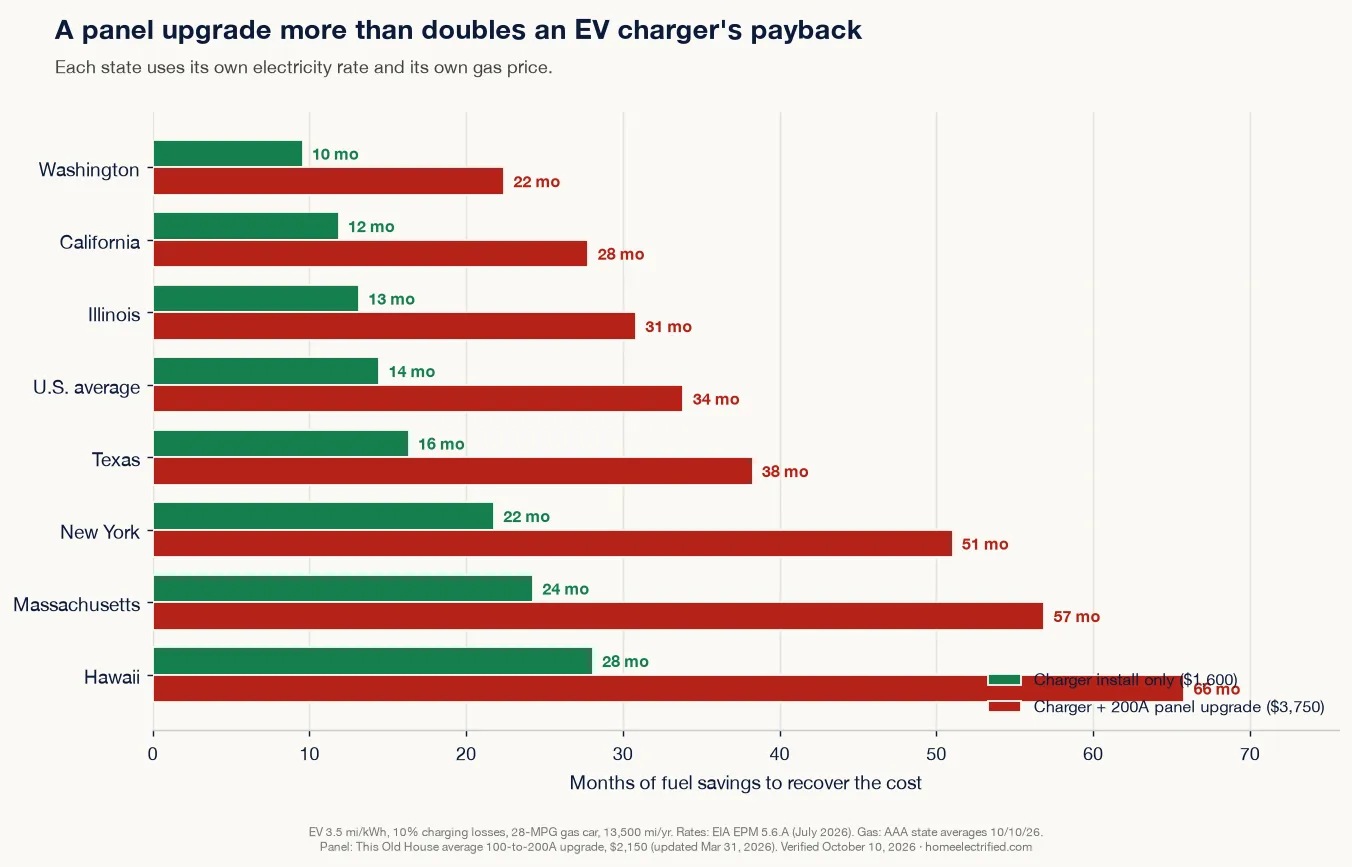
Here’s that math for an EV charger, using each state’s own electricity rate and its own gas price:
| State | Electricity (EIA, Jul 2026) | Gas (AAA, Oct 10) | EV fuel saving/yr | Charger only ($1,600) | Charger + panel ($3,750) |
|---|---|---|---|---|---|
| Washington | 14.71¢ | $5.46 | $2,007 | 10 months | 22 months |
| California | 33.61¢ | $6.31 | $1,619 | 12 months | 28 months |
| Illinois | 19.22¢ | $4.72 | $1,459 | 13 months | 31 months |
| U.S. average | 18.31¢ | $4.37 | $1,329 | 14 months | 34 months |
| Texas | 15.88¢ | $3.84 | $1,176 | 16 months | 38 months |
| New York | 29.90¢ | $4.46 | $882 | 22 months | 51 months |
| Massachusetts | 30.49¢ | $4.32 | $791 | 24 months | 57 months |
| Hawaii | 48.00¢ | $5.64 | $684 | 28 months | 66 months |
The worked version at the U.S. average: an EV at 3.5 miles per kWh with 10% charging losses costs 18.31¢ ÷ 3.5 × 1.10 = 5.75¢ a mile. A 28-MPG car at $4.367 a gallon costs 15.6¢ a mile. Over 13,500 miles that is $2,106 for gas against $777 for electricity, a $1,329 yearly saving. Then $3,750 ÷ $1,329 × 12 = 34 months.
Two things stand out. First, even the worst case on this list still pays back within six years, well inside the life of the car. Second, the panel hurts most where the EV saving is smallest. In Massachusetts and Hawaii, where electricity is expensive relative to gas, the panel upgrade adds more than two and a half years. That is where a cheaper alternative to a full upgrade is worth the most effort.
The same $2,150 lands differently on other projects. Added to the $2,900 premium of a heat pump water heater over an electric tank, it stretches that payback from about 5.2 years to 9.0 at the U.S. average. Replacing an electric tank usually reuses the existing 240V circuit, though, so this case mostly applies when you are switching from gas. On a $31,200 12 kW solar system, the same model as our solar calculator moves payback from 12.5 to about 13.4 years. That’s a small change, because the panel is a small share of a big job.
Do you actually need one?
The deciding test is a load calculation, the method in the National Electrical Code’s Article 220 that adds up what your home can draw at once. An electrician should do one before quoting you an upgrade. If they quote an upgrade without one, ask why.
The cheaper paths, in order:
- A new circuit on your existing panel, $60–$150, if the load calculation shows spare capacity and you have open breaker slots (EnergySage).
- A sub-panel, $500–$1,500, when the main panel is physically full but not over capacity, or the charger is in a detached garage (EnergySage).
- A load-management device, which keeps a charger or appliance from running at full power while other big loads are on. It can avoid the upgrade on a borderline panel. Prices and code acceptance vary by device and jurisdiction, so ask your electrician to quote it next to the upgrade.
- The full upgrade, when the load calculation says the service itself is too small.
This Old House notes that most new homes since 2015 have been built with at least 200-amp service. Older homes with 60- to 100-amp service that are adding an EV charger and electric heating, a heat pump water heater or an induction range are the most likely to need the full job. So are homes with panels from Federal Pacific Electric or Zinsco, which This Old House flags as outdated, and panels that buzz, run hot, show corrosion, or trip breakers under normal use.
What changed in 2026: the $600 credit is gone
The federal 25C Energy Efficient Home Improvement Credit used to cover 30% of the cost of a panel, up to $600, if it had at least 200 amps of capacity and was installed to support other qualifying equipment such as a heat pump. Per the IRS, the credit applies to improvements made through December 31, 2025. A panel installed in 2026 doesn’t qualify.
Some cost guides still list it. If one tells you a 2026 panel qualifies for the 30% credit up to $600, it’s out of date.
What remains is the income-qualified HEAR rebate (Home Electrification and Appliance Rebates), which pays up to $4,000 for an “electric load service center” upgrade and up to $2,500 for electrical wiring, within a $14,000 combined maximum. It’s for households under 150% of area median income. It can cover up to 100% of the cost below 80% of area median income and up to 50% between 80% and 150%. It’s applied as a discount at the point of sale, not claimed later at tax time. States run it, and whether it’s open, and what it covers, varies by state — Georgia, for example, is reopening HEAR in October 2026 only for single-family wiring and panel upgrades tied to a Home Efficiency Rebates project. Since September 1, 2026, new HEAR reservations can’t fund replacing gas, oil or propane equipment; you can add a heat pump and keep the existing system, and insulation comes first (DOE Program Notice 26-2; DOE FAQ), so a panel upgrade done to switch a gas appliance to electric may not qualify — ask your state program. Check your state energy office before you sign, and see which heat pump rebates survived in 2026 for how the same program treats heat pumps.
How to pay less
- Get the same scope quoted three times. Ask each electrician to say explicitly whether the meter base, service-entrance wire, permit and utility coordination are included. Most quote spreads come from mismatched scope.
- Ask for the load calculation in writing. It tells you whether you need the upgrade at all, and it’s the document a sub-panel or load-management alternative rests on.
- Do the electrical work once. If an EV charger, a heat pump and a heat pump water heater are all on your list, size the upgrade for all of them now. Paying for the upgrade and the utility visit once is cheaper than doing it twice.
- Line it up with a rebate. If you qualify for HEAR, the panel can be the single largest item it covers. Utility charger rebates can offset the circuit side; see which EV charger rebates are still open.
Then check the project that triggered it: Level 2 charger installation cost, what it costs to charge an EV at home in your state, or run your own numbers in the EV charging cost calculator, adding the panel quote to the install cost field.
Methodology & sources
All figures verified October 10, 2026:
- Panel and installation costs: This Old House, “What Is the Cost To Upgrade an Electrical Panel?” (updated March 31, 2026): $800–$4,000 overall, $1,300–$3,000 for 100 to 200 amps, $2,150 average; panel units by amperage (200-amp $250–$350; 200-amp panel plus installation replacing an existing panel $1,800–$2,500); sub-panel $400–$1,750; panel relocation $800–$3,000; meter box installation $1,800–$3,500; permits $50–$300; AFCI/GFCI breakers $35–$60 each; 200-amp service standard in most new homes since 2015. Cross-referenced against Angi, “How Much Does It Cost to Upgrade an Electrical Panel?” (updated August 3, 2026): 200-amp panel $250–$350, panel plus installation $1,300–$2,000, 4–8 hours of labor at $40–$250/hour, sub-panel $400–$1,750, permits $50–$300, meter box $500–$2,100 or $200–$800 (two tables on the same page).
- Service upgrade, sub-panel and circuit costs: EnergySage, “How much does an EV charger installation cost?” (updated June 22, 2026): new circuit $60–$150, sub-panel $500–$1,500, full main service upgrade $1,500–$4,000+. These match the figures already registered on our Level 2 installation guide.
- 25C credit: IRS, Energy Efficient Home Improvement Credit. Panelboards, sub-panelboards, branch circuits and feeders of 200 amps or more supporting qualifying property, $600 per item limit, improvements through December 31, 2025.
- HEAR rebate caps: ENERGY STAR, Home Electrification and Appliances Rebate Program: electric load service center $4,000, electric wiring $2,500, $14,000 combined; under 150% AMI; up to 100% of cost below 80% AMI and up to 50% at 80–150% AMI; rebates applied as a point-of-sale discount. Fuel-switching rule: DOE Program Notice 26-2 and DOE FAQ, September 2026; Georgia status: Georgia HEAR program updates, read October 11, 2026.
- Payback table: derived. EV fuel savings use EIA Electric Power Monthly Table 5.6.A residential rates (July 2026 data) and AAA state gas averages (October 10, 2026), with our standard assumptions: 3.5 mi/kWh, 10% charging losses, 28-MPG comparison car, 13,500 miles a year. The $1,600 install is our registered mid-range Level 2 figure; the $2,150 panel is This Old House’s average. Heat pump water heater and solar paybacks use the models on those pages.
- What we did not do: we did not inspect, quote or install any panel. These are published national ranges and our own arithmetic on them, not a quote for your home. Local labor rates, utility fees and code requirements move the real number, so get written quotes from licensed electricians.
Cost guides and rebate programs change; this page is re-verified on a schedule and the “verified” date reflects the latest check.
Frequently asked questions
How much does it cost to upgrade an electrical panel from 100 to 200 amps?
Most homeowners pay $1,300–$3,000, with an average around $2,150, according to This Old House (updated March 2026). Angi puts a 200-amp panel plus installation at $1,300–$2,000. If the meter base and service entrance also have to be replaced, budget $1,500–$4,000 or more (EnergySage).
Why do panel upgrade quotes vary so much?
Because 'panel upgrade' covers two different jobs. Swapping the breaker box costs $1,300–$3,000. A full service upgrade also replaces the meter box and the wires from the utility, and This Old House prices meter box installation alone at $1,800–$3,500. Ask every electrician to quote the same scope.
Is there a tax credit for a panel upgrade in 2026?
No. The federal 25C credit paid 30% up to $600 for a 200-amp-or-larger panel installed alongside qualifying equipment, but it only covered property placed in service through December 31, 2025. Some cost guides still advertise it. The income-qualified HEAR rebate, up to $4,000 for a panel, is the federal money that remains, where your state has launched it.
Do I need a panel upgrade for an EV charger or heat pump?
Not always. An electrician's load calculation decides it. If your panel has spare capacity, a new 240V circuit runs $60–$150; a sub-panel is $500–$1,500. Older 60- to 100-amp homes adding an EV charger plus electric heating or cooking are the ones that usually need the full upgrade.
Does a panel upgrade change whether an EV charger pays off?
It stretches the payback but rarely breaks it. At U.S. average prices a $1,600 charger install pays back in about 14 months; adding a $2,150 panel upgrade pushes that to about 34 months. In Hawaii, where gas and electricity are both expensive, it goes from about 28 months to 66.