Quick answer: If you buy solar in 2026, there is no federal tax credit — Section 25D expired for installations completed after December 31, 2025, going from 30% to 0% overnight with no phase-down. Two things survive: you can still claim the credit on your 2025 return if you installed last year, and leases and PPAs can still access 30% through Section 48E, though the company claims it, not you. A few states still offer their own credits; most don’t.
Last verified: August 2, 2026. Credit status: One Big Beautiful Bill Act / IRS. State programs: EnergySage and DSIRE. System pricing: EnergySage Marketplace (June 30, 2026).
What exactly happened
The One Big Beautiful Bill Act, signed July 4, 2025, repealed the residential clean energy credit. The mechanics that matter:
- Section 25D paid 30% of your total system cost, uncapped, for systems you owned. Panels, inverters, labor, permits, and in most cases batteries all counted.
- It expired for installations completed after December 31, 2025. Not reduced — repealed.
- There was no phase-down. Previous solar credit expirations stepped down 30% → 26% → 22%. This one went to zero on January 1, 2026.
That last detail is why so much of the web is wrong about this. Guides written before mid-2025 confidently describe a step-down schedule that no longer exists, and plenty of them still rank.
If you installed in 2025, claim it — you haven’t missed anything
This is the part people get wrong in the other direction. The credit didn’t vanish retroactively. If your system was purchased and installed before December 31, 2025, it’s still yours to claim:
- IRS Form 5695 — Residential Energy Credits, where you calculate it.
- Schedule 3 — where the result gets reported as a nonrefundable credit.
- Form 1040 — your return.
It’s non-refundable, meaning it can zero out your tax bill but won’t generate a refund beyond that. If your liability was smaller than the credit, the unused portion carries forward.
If you installed in 2025 and haven’t filed yet, or filed without claiming it, this is worth a conversation with whoever does your taxes — an amended return is possible. We’re describing how the credit works, not giving tax advice; your situation is yours and a professional should confirm it.
What the loss is actually worth
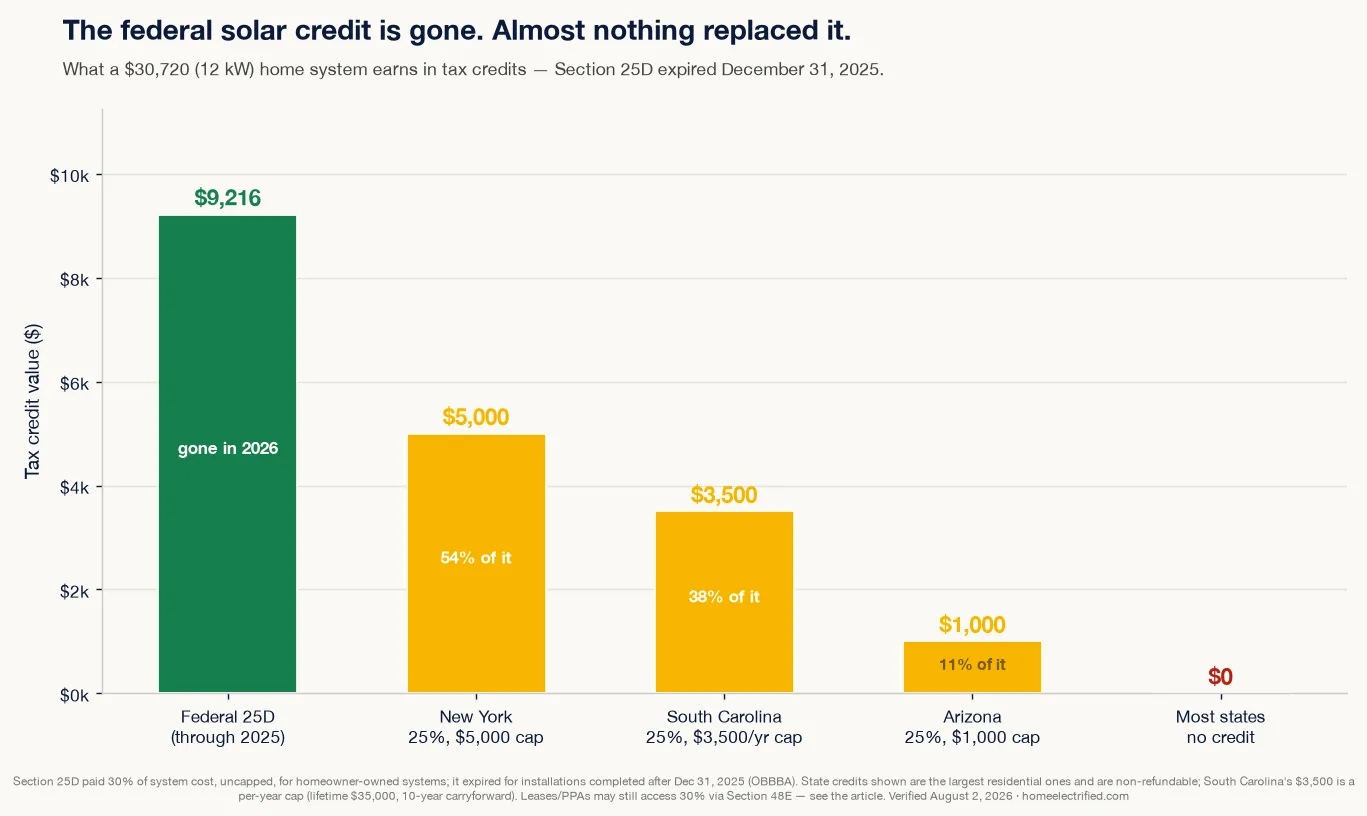
On the national-average quoted system — 12 kW at about $30,720 — the federal credit was worth $9,216. Here’s what the best remaining state credits do against that:
| Credit | Rate | Cap | Worth on a $30,720 system | Share of the old federal credit |
|---|---|---|---|---|
| Federal 25D (through 2025) | 30% | none | $9,216 | — (expired) |
| New York | 25% | $5,000 | $5,000 | 54% |
| South Carolina | 25% | $3,500/yr | $3,500/yr | 38% in year one |
| Arizona | 25% | $1,000 | $1,000 | 11% |
| Most states | — | — | $0 | 0% |
South Carolina’s is the most generous over time rather than up front: the $3,500 is a per-year cap against a lifetime maximum of $35,000, with a 10-year carryforward, so 25% of a $30,720 system ($7,680) can be realised across about three years if your state tax liability supports it.
The honest summary: even the best state credit replaces roughly half of what the federal one paid, and in most of the country nothing replaced it at all.
The lease/PPA loophole — and its closing window
The one route to a 30% federal credit on a home system in 2026 is not owning it. Third-party-owned solar — a lease or a power purchase agreement — is treated as a business asset, so the provider claims the Section 48E commercial credit.
The deadlines have tightened, and one has already passed:
- Projects that began construction by July 4, 2026 get a four-year safe-harbor window to be placed in service.
- Anything starting construction after July 4, 2026 must be placed in service by December 31, 2027.
Since that first date is behind us, a lease signed today generally depends either on a provider who safe-harboured equipment before the deadline, or on getting your system running before the end of 2027. If a salesperson tells you “you still get the 30% credit,” ask specifically which of those two applies to your project.
Worth being clear-eyed about what a lease is: you don’t own the system, you don’t claim anything on your own return, and you give up most of the long-term savings in exchange for a lower monthly payment and no upfront cost. The provider keeps the credit and passes through what it chooses to. It’s a real option, especially if you have little tax liability to offset anyway — but it is not the old credit in a new wrapper. We modelled how much of it actually reaches you in solar lease vs buy vs PPA: a provider claiming 48E produces power at roughly 6.6¢/kWh and sells it to you at 15.8–20.2¢.
What still pays in 2026
Federal tax credits aren’t the only money on the table:
- State tax credits — the table above covers the largest; check DSIRE for your state.
- SREC markets — Massachusetts, Illinois, New Jersey, Maryland and D.C. pay per megawatt-hour generated, often for 10–15 years. In a strong SREC state this can be worth more over time than the federal credit was up front.
- Utility rebates — usually modest and first-come, first-served, and they do run out of funds mid-year.
- Property and sales tax exemptions — widespread and easy to overlook. Many states don’t add solar to your assessed property value; some waive sales tax on equipment.
- Net metering — not an incentive exactly, but what your utility pays for exported power shapes lifetime economics more than any rebate. Check your utility’s current rules before sizing a system, because export rates have been falling.
This is the same pattern that hit home heating: the 25C heat pump credit expired on the same date, leaving state and utility programs to carry the load.
Does solar still make sense without it?
Losing 30% is a real hit, not a rounding error — it pushed typical payback from 8.7 years to 12.5 years at the U.S. average electricity rate of 18.31¢/kWh. But a system is warrantied 25 years, so a 12.5-year payback still leaves about 13 years of nearly free power.
The deciding factor is your electricity rate, not the credit. Where power is expensive the case survives comfortably; where it’s cheap, the math got hard. Our full breakdown of what solar costs in 2026 works through the payback math and the roughly $1-per-watt spread between competitive quotes and doorstep pricing.
Methodology & sources
Verified August 2, 2026:
- 25D repeal: the One Big Beautiful Bill Act (signed July 4, 2025) ended the Section 25D residential clean energy credit for installations completed after December 31, 2025, with no phase-down. Confirmed against EnergySage’s federal credit explainer.
- Claiming a 2025 install: IRS Form 5695 → Schedule 3 → Form 1040; non-refundable with carryforward of unused amounts.
- Section 48E (leases/PPAs): construction-start deadline of July 4, 2026 for the four-year safe harbor; projects starting after that must be placed in service by December 31, 2027.
- State credits: New York 25% up to $5,000; South Carolina 25% capped $3,500/year against a $35,000 lifetime maximum with 10-year carryforward, non-refundable; Arizona 25% up to $1,000. Sources disagreed on whether South Carolina’s credit is capped — we used the per-year/lifetime cap figures, which the state-specific guides agree on. Check DSIRE for current status before relying on any of them.
- System price: $30,720 for 12 kW, the national average quoted system on the EnergySage Marketplace (updated June 30, 2026).
- Payback figures: derived — installed cost ÷ (annual production × electricity rate), at 1,300 kWh per kW per year and 18.31¢/kWh (EIA, July 2026 data, re-checked October 10, 2026).
- This is a description of how these programs work, not tax advice. Incentive rules change and eligibility depends on your circumstances — confirm with a tax professional and with the program itself before you buy.
Incentive programs change frequently; this page is re-verified on a schedule and the “verified” date reflects the latest check.
Frequently asked questions
Is there still a federal solar tax credit in 2026?
Not if you buy the system yourself. The 30% Section 25D residential credit expired for installations completed after December 31, 2025, with no phase-down — it went straight from 30% to 0% on January 1, 2026. A federal credit does still exist for leased and PPA systems under Section 48E, but the leasing company claims it, not you.
Can I still claim the solar tax credit for a system installed in 2025?
Yes. If your system was purchased and installed before December 31, 2025, you claim it on your 2025 tax return using IRS Form 5695, carried to Schedule 3 and then Form 1040. The credit is non-refundable but unused amounts can carry forward.
How much did the solar tax credit expiry cost homeowners?
About 30% of the system price. On a typical $30,720 (12 kW) system that's $9,216 you would have received in 2025 and get nothing for in 2026. Typical payback stretched from 8.7 years to 12.5 years at the registered $2.60/W ($31,200).
Can I still get 30% off solar through a lease or PPA in 2026?
Sometimes, indirectly. Third-party-owned systems can use the Section 48E commercial credit, but the deadlines tightened: projects that began construction by July 4, 2026 have a four-year window, while anything starting after that must be placed in service by December 31, 2027. The provider claims the credit and passes some of it through as a lower rate — you never see it on your own tax return.
Which states still have a solar tax credit in 2026?
A handful. New York offers 25% up to $5,000, South Carolina 25% capped at $3,500 per year (lifetime $35,000, 10-year carryforward), and Arizona 25% up to $1,000. Most states have no residential solar tax credit at all, though many have rebates, SREC markets or property-tax exemptions.
Will the solar tax credit come back?
There is no scheduled return. The One Big Beautiful Bill Act repealed 25D outright rather than phasing it down, so restoring it would take new legislation. Plan on the rules as they are today rather than betting on a reversal.