Quick answer: A heat pump water heater costs $3,200–$4,700 installed in 2026, averaging about $4,200 — roughly $2,900 more than a standard electric tank. It pays that back by cutting annual water-heating cost from $761 to $200 at the U.S. average electricity rate, a saving of about $561 a year. That’s a 5-year payback nationally, under 3 years in high-rate states, and about 2 years if you qualify for an income-based HEAR rebate.
Last verified: October 10, 2026 for electricity and gas prices; October 11, 2026 for installed costs (Angi, unchanged) and HEAR rules (other incentives: August 7, 2026). Costs cross-referenced from Angi and Rewiring America; efficiency and savings from ENERGY STAR and the DOE Uniform Energy Factor test procedure; electricity and gas prices from EIA. Full sources and assumptions in the methodology section.
What you’ll actually pay
A heat pump water heater (also sold as a “hybrid” water heater) works like a refrigerator in reverse: instead of burning fuel or running current through a heating element, it moves heat out of the surrounding air and into the tank. Moving heat is several times cheaper than making it, which is the entire reason these cost more upfront and less to run.
Two independent 2026 cost surveys line up closely:
| Source | Typical installed cost | Full range |
|---|---|---|
| Angi (2026 data) | $3,200–$4,700 (avg $4,200) | $2,800–$8,000 |
| Rewiring America | $3,600–$6,500 | — |
The single biggest swing factor isn’t the tank — it’s what you’re replacing:
| Scenario | Installed cost | Why |
|---|---|---|
| Replacing an existing electric tank | $3,600–$4,800 | The 240V circuit is already there |
| Replacing a gas tank | $4,300–$6,500 | Needs a new 240V circuit; gas line capped, vent removed |
Tank size matters less than people expect. Angi’s equipment pricing runs $1,100–$1,300 for a 50-gallon unit and $2,000–$2,500 for an 80-gallon — a few hundred dollars of difference on a job where labor is about half the total bill. Most homes are fine on 50 or 60 gallons; heat pump models recover more slowly than resistance tanks, so sizing up one step is a common and cheap hedge.
What it costs to run: the number that decides this
Here’s the calculation, shown plainly, so you can check it against your own rate.
A family of four uses about 64 gallons of hot water a day (the DOE planning figure). Heating that water from a 58°F inlet to 125°F — the DOE’s own test conditions — takes:
64 gal × 8.34 lb/gal × 67°F = 35,762 BTU/day → 13.05 million BTU/year
That’s the heat you need regardless of appliance. What changes is how much energy you buy to deliver it, and that’s what the Uniform Energy Factor (UEF) measures — DOE’s efficiency rating, where higher is better:
| Water heater | UEF | Energy bought per year | Annual cost |
|---|---|---|---|
| Electric resistance tank | 0.92 | 4,158 kWh | $761 |
| Gas storage tank | 0.64 | 204 therms | $318 |
| Heat pump water heater | 3.5 | 1,093 kWh | $200 |
| Heat pump water heater (best-in-class) | 4.0 | 956 kWh | $176 |
At 18.31¢/kWh and $1.56/therm. A UEF above 1.0 isn’t a rounding error — a heat pump delivers ~3.5 units of heat per unit of electricity because it’s moving heat, not creating it.
Our independent result: $561/year saved versus electric resistance. ENERGY STAR publishes $550 for a family of four. We computed ours from the DOE test procedure and current EIA prices without reference to theirs, and landed within 2% — which is a good sign for both numbers.
The gas comparison is the one that surprises people: at national average prices a heat pump water heater runs $118 a year cheaper than gas, because 3.5× efficiency beats cheap fuel.
But that margin does flip, and we can say exactly where. A heat pump buys 1,093 kWh a year; a gas tank costs $318 a year at $1.56/therm. Divide one by the other and the crossover is 29.1¢/kWh:
- Below ~29¢/kWh — 46 states, counting D.C. — the heat pump is cheaper to run than gas.
- Above ~29¢/kWh — Hawaii, California, Maine, Massachusetts, and New York — a gas tank is cheaper to run, though the heat pump still crushes electric resistance.
If you’re in one of those four states and already have gas, the running-cost case for switching fuels is weak; the case for replacing an electric tank is still overwhelming.
Savings and payback by state
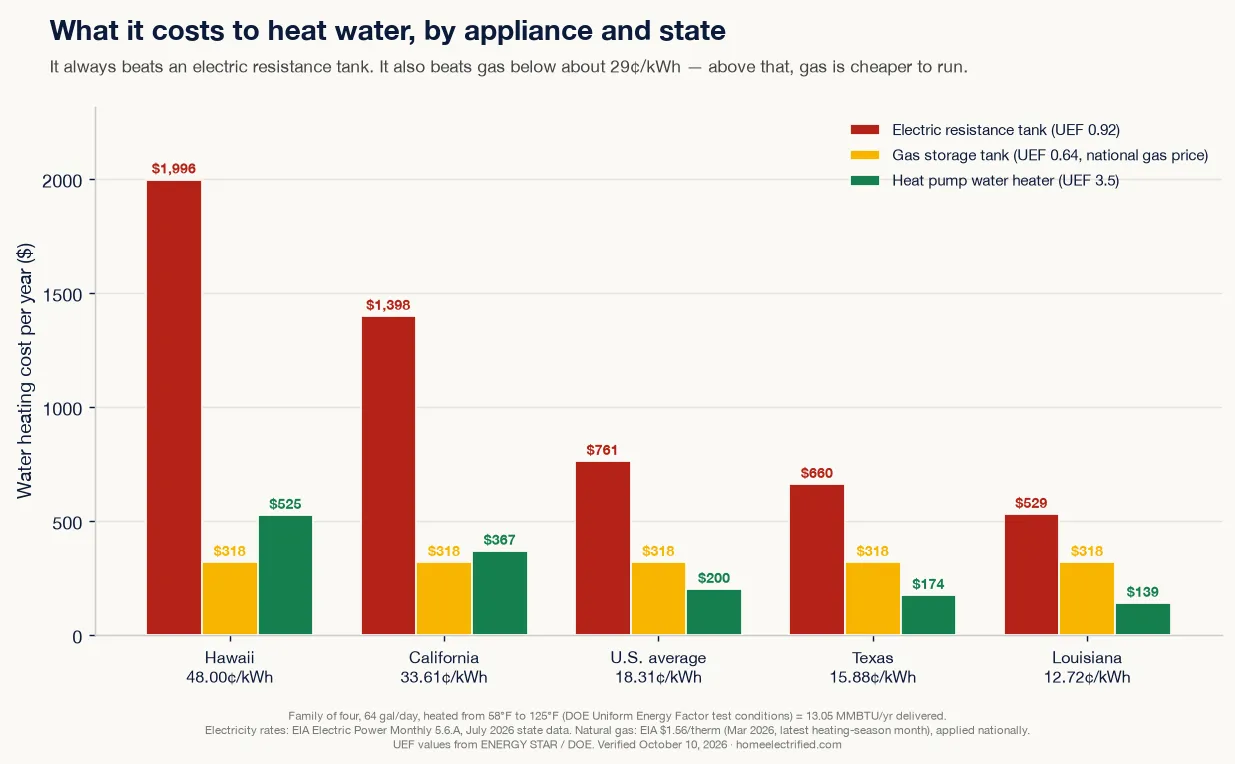
Because a heat pump water heater’s advantage is proportional to your electricity rate, the same appliance is a 2-year investment in one state and a 7-year one in another. Payback below assumes the $2,900 premium over a standard electric tank ($4,200 average installed vs ~$1,300 for a basic electric replacement):
| State | Electricity rate | Electric resistance | Heat pump | Saves/year | Payback | With HEAR rebate |
|---|---|---|---|---|---|---|
| Hawaii | 48.00¢ | $1,996 | $525 | $1,471 | 2.0 yr | 0.8 yr |
| California | 33.61¢ | $1,398 | $367 | $1,030 | 2.8 yr | 1.1 yr |
| Maine | 32.41¢ | $1,348 | $354 | $993 | 2.9 yr | 1.2 yr |
| Massachusetts | 30.49¢ | $1,268 | $333 | $935 | 3.1 yr | 1.2 yr |
| New York | 29.90¢ | $1,243 | $327 | $916 | 3.2 yr | 1.3 yr |
| U.S. average | 18.31¢ | $761 | $200 | $561 | 5.2 yr | 2.0 yr |
| Texas | 15.88¢ | $660 | $174 | $487 | 6.0 yr | 2.4 yr |
| Florida | 15.03¢ | $625 | $164 | $461 | 6.3 yr | 2.5 yr |
| Louisiana | 12.72¢ | $529 | $139 | $390 | 7.4 yr | 2.9 yr |
Heat pump water heaters typically last 12–15 years, so every state on this list pays back inside the appliance’s life — the question is whether it’s a third of the life or two-thirds. The “With HEAR rebate” column applies the $1,750 income-qualified federal rebate described below.
The decision rule: if you’re already replacing a failed electric tank, the premium is $2,900 and the math above applies. If your current tank still works, you’re comparing against $0 spent, and the honest answer is to wait — but size the electrical circuit for a heat pump now if you’re doing panel work anyway.
What changed in 2026: the tax credit is gone
The federal 25C Energy Efficient Home Improvement Credit — 30% of project cost, up to $2,000 for a heat pump water heater — expired December 31, 2025 and has not been renewed. Installations completed on or before that date can still be claimed on a 2025 return; anything after cannot.
This is the single most common error on the web right now. Rewiring America’s own cost page, which we used as a pricing source, still lists “IRA Tax Credit: 30% up to $2,000” as available. Manufacturer and retailer pages repeat it. It is not available, and a $2,000 credit is large enough to change a purchase decision, so verify it against the IRS page before believing any site — including this one.
What’s still available
- HEAR rebates (federal, income-qualified): up to $1,750 for a heat pump water heater, delivered at point of sale, for households under 150% of area median income. These are state-administered and their status varies sharply — California’s program is fully reserved as of February 2026 (waitlist only), while several states launched during 2026. Since September 1, 2026, new HEAR reservations can’t fund replacing a gas or propane water heater — only upgrading an existing electric one (or new construction) — under DOE Program Notice 26-2 and the DOE FAQ. The “With HEAR rebate” column above compares against an electric-resistance tank, which still qualifies. Check your state energy office.
- Utility and state rebates: commonly $500–$1,500. Rewiring America cites Massachusetts at $750–$1,500 and California at $500–$900. Because these move as fast as the EV charger programs we re-verify monthly, confirm with your utility before you buy.
Where these don’t work well
The honest limits, because they matter more than the savings:
- They need air, and space. A heat pump water heater extracts heat from the room it stands in, so it wants roughly 700–1,000 cubic feet of surrounding air. A sealed closet won’t work without louvered doors or ducting.
- They need warmth. Efficiency falls with air temperature, and below about 40°F most units fall back on their resistance elements — at which point you’re running an expensive electric tank. A garage in Minnesota is a poor location; a basement in Georgia is a great one.
- They cool and dry the space. In a humid basement that’s a free dehumidifier. Next to a finished living area, it’s a complaint.
- They’re slower to recover than a resistance tank, and they make noise — roughly the level of a window air conditioner, which is a real consideration next to a bedroom.
- Replacing gas costs more, because you’re adding a 240V circuit. If your panel is full, price a panel upgrade or a load-management device into the decision — that’s the same constraint EV chargers and heat pumps hit.
How this fits the rest of your electrification
Water heating is usually the second-largest energy load in a home, behind space heating. That makes a heat pump water heater the cheapest large efficiency win available in 2026 — a $2,900 premium versus $6,000–$13,000 for a ducted heat pump — and it’s the one that survived the credit expirations in the best shape, because the HEAR rebate is still funded where states have launched it.
If you’re planning several projects, the sequencing that saves the most money is: do the electrical work once. A panel upgrade for a heat pump water heater, an EV charger, and a whole-home heat pump is one job, not three. See also what heat pump rebates survived in 2026.
Methodology & sources
Installed costs and incentives verified August 7, 2026; electricity and gas prices re-verified October 10, 2026:
- Installed costs: Angi’s 2026 heat pump water heater installation data ($3,200–$4,700 typical, $4,200 average, $2,800–$8,000 full range; equipment by tank size; labor ≈ half of a simple job) cross-referenced against Rewiring America ($3,600–$6,500 upfront; $3,600–$4,800 replacing electric; $4,300–$6,500 replacing gas; unit $1,200–$2,500). Standard electric tank replacement ($800–$1,800 installed, ~$1,300 midpoint) from 2026 contractor cost guides.
- Efficiency and savings: ENERGY STAR ($550/year for a family of four, $5,600 lifetime; UEF 3.5–4.0 for heat pump models vs ~0.90–0.92 for electric resistance).
- Running-cost calculation (ours): 64 gal/day hot water for a family of four; 58°F inlet to 125°F outlet per the DOE Uniform Energy Factor test procedure; 8.34 lb/gal; 3,412 BTU/kWh; 100,000 BTU/therm. Efficiencies: 0.92 electric resistance, 3.5 heat pump (conservative within the ENERGY STAR range), 0.64 gas storage.
- Energy prices: EIA Electric Power Monthly Table 5.6.A, July 2026 state data — U.S. average 18.31¢/kWh; natural gas $1.56/therm (EIA, March 2026 as revised September 30, 2026, the latest heating-season month).
- 25C expiration: IRS Energy Efficient Home Improvement Credit and Rewiring America’s 25C water heater page — credit expired for property placed in service after December 31, 2025.
- HEAR rebates: U.S. Department of Energy Home Electrification and Appliance Rebates, up to $1,750 for heat pump water heaters at under 150% AMI; state-administered, availability confirmed as varying by state (California fully reserved as of February 2026). Fuel-switching (replacing a gas or propane water heater) removed for new reservations from September 1, 2026: DOE Program Notice 26-2 and DOE FAQ, September 2026, read October 11, 2026.
These are planning figures, not quotes — get two or three local bids, and confirm any rebate with the administering program before you buy. Costs and incentives are re-verified on a schedule; the “verified” date above reflects the latest check.
Frequently asked questions
How much does a heat pump water heater cost installed in 2026?
$3,200–$4,700 for a typical installation, averaging about $4,200. The full range runs $2,800 to $8,000 depending on tank size, electrical work, and whether you're replacing gas. Replacing an existing electric tank is cheapest ($3,600–$4,800); switching from gas costs more ($4,300–$6,500) because you need a new 240V circuit.
How much does a heat pump water heater save per year?
About $561 a year versus a standard electric resistance tank at the U.S. average electricity rate of 18.31¢/kWh — our own calculation, which lands within 2% of ENERGY STAR's published $550 estimate. Savings scale with your rate: roughly $390/year in Louisiana and $1,471/year in Hawaii.
What is the payback period on a heat pump water heater?
About 5 years at the U.S. average electricity rate, based on a $2,900 premium over a standard electric tank and $561/year in savings. It's under 3 years in high-rate states like Hawaii and California, and closer to 7 years in the cheapest-power state, Louisiana. Income-qualified HEAR rebates cut the national payback to about 2 years.
Is there still a tax credit for heat pump water heaters in 2026?
No. The federal 25C credit (30% of cost, up to $2,000 for heat pump water heaters) expired December 31, 2025 and has not been renewed. Installations completed by that date can still be claimed on a 2025 return. Many manufacturer and advocacy pages still advertise this credit — they are out of date.
Is a heat pump water heater cheaper to run than gas?
Yes in 46 states (counting D.C.) — about $200 a year versus $318 for a standard gas storage tank at national average prices. The crossover is 29.1¢/kWh: above that rate a gas tank is cheaper to run, which today means Hawaii, California, Maine, Massachusetts and New York. Everywhere else the heat pump wins on running cost as well as against electric resistance.
Do heat pump water heaters work in a cold garage or basement?
They pull heat from surrounding air, so they need roughly 700–1,000 cubic feet of space and work best between about 40°F and 90°F. In an unconditioned space that drops below 40°F they fall back on electric resistance elements and lose their efficiency advantage. They also cool and dehumidify the space they sit in — a benefit in a humid basement, a drawback next to a finished room.