Quick answer: A gas furnace is far cheaper to run. At 2026 U.S. averages, an electric furnace costs about $53 per million BTU of heat, versus $16.42 for a new 95% gas furnace and $19.50 for an older 80% one: 2.7 to 3.2 times as much. For a typical gas-heated home, that’s $1,913 a year versus $700.
Last verified: November 27, 2026 for electricity (EIA Electric Power Monthly, September 2026 state data, released November 24, 2026; next release December 23); other inputs November 20, 2026 unless noted. Natural gas: EIA U.S. and state residential prices, March 2026, the latest heating-season month in EIA’s October 30, 2026 release. Propane: EIA Heating Oil and Propane Update, week of November 16, 2026. Heating loads and furnace counts: EIA Residential Energy Consumption Survey (RECS) 2020. Installed costs: Angi, HomeGuide and Fixr. Sources and dates in the methodology section.
Electric furnace vs gas furnace: the cost of one unit of heat
Both appliances do the same job: they heat air and a blower pushes it through your ducts. The difference is the fuel. An electric furnace runs current through resistance coils, so close to 100% of the electricity becomes heat (HomeGuide lists electric furnaces at 100 AFUE). A gas furnace burns natural gas and loses some heat up the flue: AFUE (annual fuel utilization efficiency) is the share that reaches your home, from 80% for a basic model to 95% and up for a condensing one.
The fair way to compare them is the price of one million BTU of delivered heat:
- Electric furnace: 1,000,000 ÷ 3,412 BTU per kWh = 293.07 kWh. At 18.17¢/kWh: 293.07 × $0.1817 = $53.25.
- New 95% gas furnace: 10 therms ÷ 0.95 = 10.53 therms. At $1.56/therm: 10.53 × $1.56 = $16.42.
- Older 80% gas furnace: 10 ÷ 0.80 = 12.5 therms × $1.56 = $19.50.
$53.25 ÷ $16.42 = 3.2×, and $53.25 ÷ $19.50 = 2.7×. The ratio is what matters, because gas and electricity prices both move. Electricity per kWh is simply an expensive way to buy heat when nothing multiplies it.
Why the water-heater crossover doesn’t apply here
On our heat pump water heater page, gas wins only above about 29¢/kWh. That is because a heat pump moves heat instead of making it, delivering several units of heat per unit of electricity. An electric furnace has no such multiplier. Run the same break-even math for a furnace (gas cost per million BTU ÷ 293.07 kWh) and the crossover falls to about 5.6¢/kWh against a 95% gas furnace and 6.7¢/kWh against an 80% one. The cheapest state average in EIA’s September 2026 data is Nevada at 13.25¢, roughly double that.
Flip it around and the same conclusion holds: at the U.S. average electricity rate, gas would need to cost more than about $5.06 a therm (95% furnace) or $4.26 (80%) before an electric furnace came out ahead. The U.S. heating-season average was $1.56.
Electric vs gas furnace monthly cost
Your gas bill already tells you how much heat you use. Take a cold month in which an 80% gas furnace burns 100 therms:
- Gas: 100 × $1.56 = $156.
- Heat delivered: 100 therms × 0.80 = 80 therms = 8 million BTU.
- Same heat from an electric furnace: 8 × 293.07 = 2,345 kWh, or 2,345 × $0.1817 = about $426.
If your current furnace is a 95% model, the same 100 therms delivered more heat, so the electric equivalent is 2,784 kWh, about $506. To check your own home, multiply the therms on a winter bill by your furnace’s AFUE, then by 29.31 to get kWh, then by your electricity rate.
The hourly view says the same thing. Ten kilowatts of electric heat, a common size for heat strips, uses 10 kWh every hour it runs: about $1.82 an hour at the U.S. average rate.
What a year of heat costs by climate
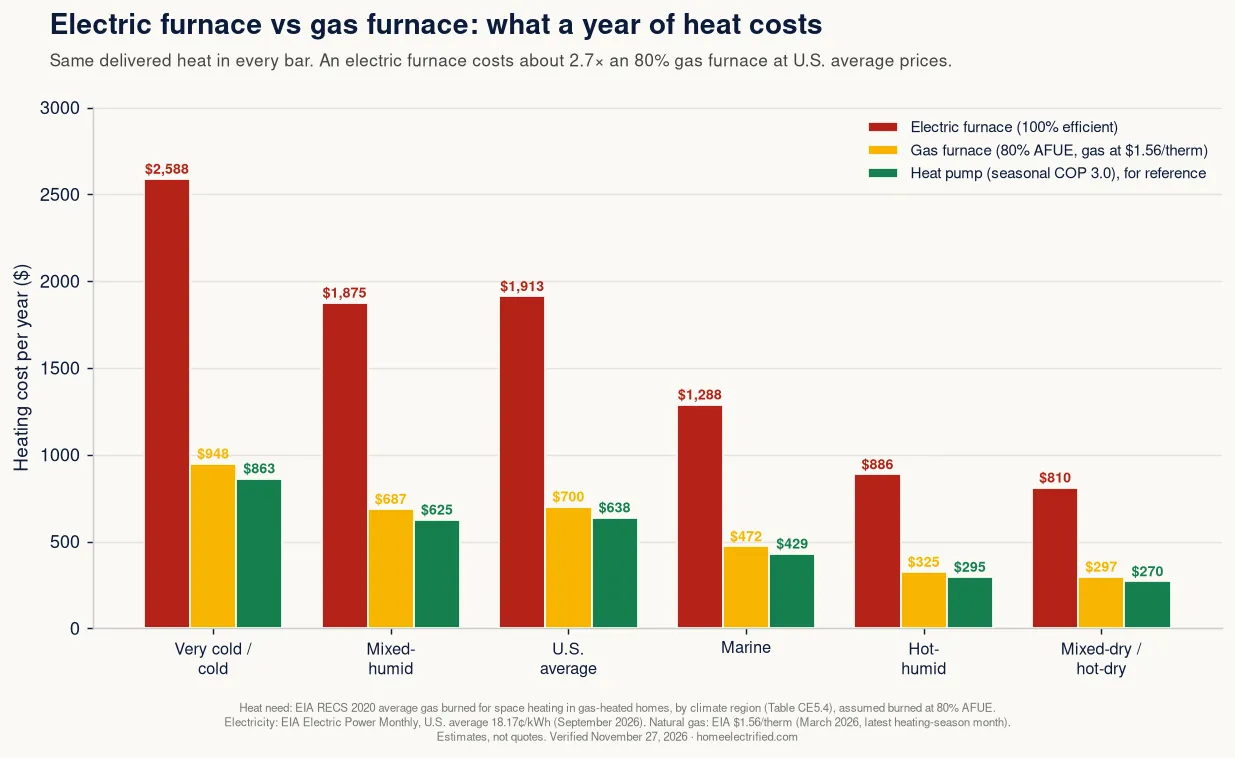
To turn per-BTU prices into annual bills we used EIA’s own survey of how much gas homes burn for space heating. In RECS 2020, the average home that heats with natural gas used 44.9 million BTU (about 449 therms) of gas for heat. We assume that gas was burned in an 80% furnace, which delivers 35.9 million BTU to the house, then price the same delivered heat for each option.
| Climate region (RECS) | Gas used for heat | Gas furnace (80%) | Electric furnace, same heat | Extra cost of electric | Heat pump, COP 3.0 |
|---|---|---|---|---|---|
| Very cold / cold | 608 therms | $948 | $2,588 (14,244 kWh) | +$1,640 | $863 |
| Mixed-humid | 440 therms | $687 | $1,875 (10,318 kWh) | +$1,188 | $625 |
| U.S. average | 449 therms | $700 | $1,913 (10,526 kWh) | +$1,212 | $638 |
| Marine | 302 therms | $472 | $1,288 (7,089 kWh) | +$816 | $429 |
| Hot-humid | 208 therms | $325 | $886 (4,878 kWh) | +$562 | $295 |
| Mixed-dry / hot-dry | 190 therms | $297 | $810 (4,457 kWh) | +$513 | $270 |
U.S. average prices (18.17¢/kWh, $1.56/therm) applied to every region so the only variable is how much heat the climate needs. Gas use is the RECS 2020 average per home that heats with natural gas.
Two things stand out. In a cold climate, choosing an electric furnace over gas costs around $1,600 a year, more than the price gap between the two furnaces (see below). In a hot climate the penalty is smaller in dollars, a few hundred a year, because the heat runs so little, but it is still close to triple.
The green bars are there for context: at a seasonal COP of 3.0, a heat pump delivers the same heat for about a third of the electric furnace’s cost, and close to what gas costs. That comparison has its own page: heat pump vs gas furnace running cost.
Is a gas furnace cheaper than electric in every state?
Yes, everywhere EIA publishes both prices. State averages change the size of the gap, not the winner. This table uses each state’s own electricity rate (September 2026) and its own residential gas price (March 2026).
| State | Electricity | Gas (March 2026) | Electric furnace $/million BTU | New 95% gas furnace $/million BTU | Electric costs |
|---|---|---|---|---|---|
| Nevada | 13.25¢ | $0.97/therm | $38.83 | $10.20 | 3.8× gas |
| Tennessee | 13.29¢ | $1.50/therm | $38.95 | $15.79 | 2.5× gas |
| Kentucky | 13.54¢ | $1.85/therm | $39.68 | $19.43 | 2.0× gas |
| North Dakota | 14.29¢ | $0.80/therm | $41.88 | $8.40 | 5.0× gas |
| Idaho | 14.39¢ | $0.75/therm | $42.17 | $7.89 | 5.3× gas |
| Arkansas | 14.54¢ | $2.37/therm | $42.61 | $24.95 | 1.7× gas |
| Arizona | 14.92¢ | $1.90/therm | $43.73 | $20.01 | 2.2× gas |
| Oklahoma | 15.22¢ | $1.54/therm | $44.61 | $16.21 | 2.8× gas |
| Texas | 15.91¢ | $2.38/therm | $46.63 | $25.01 | 1.9× gas |
| Georgia | 16.27¢ | $1.78/therm | $47.68 | $18.71 | 2.5× gas |
| Minnesota | 17.37¢ | $1.18/therm | $50.91 | $12.44 | 4.1× gas |
| Virginia | 17.74¢ | $1.81/therm | $51.99 | $19.05 | 2.7× gas |
| Colorado | 17.88¢ | $1.12/therm | $52.40 | $11.83 | 4.4× gas |
| U.S. average | 18.17¢ | $1.56/therm | $53.25 | $16.42 | 3.2× gas |
| Ohio | 19.09¢ | $1.33/therm | $55.95 | $13.97 | 4.0× gas |
| Illinois | 19.14¢ | $1.17/therm | $56.09 | $12.29 | 4.6× gas |
| Wisconsin | 19.42¢ | $0.92/therm | $56.91 | $9.63 | 5.9× gas |
| Pennsylvania | 22.20¢ | $1.61/therm | $65.06 | $16.94 | 3.8× gas |
| Michigan | 23.17¢ | $1.09/therm | $67.90 | $11.50 | 5.9× gas |
| New Jersey | 24.64¢ | $1.37/therm | $72.21 | $14.44 | 5.0× gas |
| Alaska | 28.00¢ | $1.25/therm | $82.06 | $13.17 | 6.2× gas |
| New York | 28.42¢ | $1.82/therm | $83.29 | $19.20 | 4.3× gas |
| California | 30.86¢ | $2.00/therm | $90.44 | $21.05 | 4.3× gas |
| Massachusetts | 30.97¢ | $2.62/therm | $90.76 | $27.61 | 3.3× gas |
| Hawaii | 48.31¢ | $5.88/therm | $141.58 | $61.87 | 2.3× gas |
Selected states. EIA had no March 2026 residential gas price for Florida, Louisiana, Maine, North Carolina, South Carolina or Washington, so they are left out rather than estimated. Gas converted at EIA’s 1,036 BTU per cubic foot (10.36 therms per thousand cubic feet).
The smallest gap is in states where gas is relatively expensive and power is cheap, like Arkansas (1.7×) and Texas (1.9×). The biggest is where gas is cheap and power is not: Wisconsin (5.9×), Michigan (5.9×) and Alaska (6.2×). Even Hawaii, with the country’s most expensive gas, has electric heat at 2.3 times the cost.
Electric furnace vs gas furnace: installation cost
The electric furnace’s one financial advantage is the price tag. It has no burner, flue or gas line, and the cost guides agree it is cheaper to install:
| Source (updated) | Electric furnace, installed | Gas furnace, installed |
|---|---|---|
| Angi (electric Oct 20, 2026; gas Oct 29, 2026) | $2,240–$8,116, average $5,137 | $3,800–$10,000, average $7,000 (high-efficiency up to $12,000) |
| HomeGuide (electric Feb 5, 2026; furnace guide Dec 31, 2025) | $1,900–$5,600, average $3,750 | $3,800–$12,000 |
| Fixr (Jan 28, 2026) | $1,800–$7,300 | $3,800–$10,000 |
Using one source for both sides, Angi’s averages put the electric furnace about $1,863 cheaper up front ($7,000 − $5,137). The running cost takes that back quickly. Compare it with a new 95% gas furnace heating the U.S.-average home (35.9 million BTU delivered):
- 95% gas: 35.9 ÷ 0.95 × 10 × $1.56 = $590 a year.
- Electric: $1,913 a year.
- Difference: $1,323 a year, so the $1,863 head start is gone in $1,863 ÷ $1,323 × 12 = about 17 months.
Over ten years at today’s prices, that is roughly $12,900 for gas ($7,000 + 10 × $590) against $24,250 for electric ($5,137 + 10 × $1,913). Furnace lifespan doesn’t rescue the electric option either: HomeGuide says electric furnaces last 20 to 30 years, about five more than gas, but the extra years don’t make up a gap of more than $1,000 a year.
Two items change the install math. If the house has no gas line, HomeGuide prices a new one at $350 to $2,000 or more, and Angi at $250 to $800 for a first gas furnace. An electric furnace, on the other hand, needs a large 240-volt circuit and sometimes a bigger panel: 10 kW of electric heat adds about 42 amps in a load calculation, and our panel upgrade cost guide covers what a 200-amp upgrade runs.
Are most furnaces gas or electric?
Gas, by a wide margin. EIA’s RECS 2020 counted 74.4 million U.S. homes whose main heating is a central warm-air furnace:
| Furnace fuel | Homes | Share |
|---|---|---|
| Natural gas | 53.3 million | 72% |
| Electricity | 13.8 million | 19% |
| Propane | 4.0 million | 5% |
| Fuel oil or kerosene | 3.1 million | 4% |
Across all equipment types, 42.6 million homes heat mainly with electricity, but only a third of them use an electric furnace. More (16.1 million) use a heat pump, and the rest use baseboards, built-in units or portable heaters.
Does a gas furnace use a lot of electricity?
No. A gas furnace makes its heat from gas; electricity runs only the blower, the inducer fan and the controls. RECS 2020 estimates the average household’s air-handler fan use for heating at 233 kWh a year, about $42 at 18.17¢/kWh. In very cold and cold climates, where the fan runs longer, it averages 395 kWh, about $72. An electric furnace uses a fan too, so that cost is the same either way. The practical catch is outages: a gas furnace still needs power for the blower, so it won’t heat the house when the grid is down unless you have backup power.
Electric furnace vs propane furnace
Propane changes the picture more than natural gas does, because propane is pricier per BTU. EIA’s weekly survey had U.S. residential propane at $2.817 a gallon for the week of November 16, 2026, and a gallon holds 91,452 BTU (EIA):
- 95% propane furnace: 1,000,000 ÷ 91,452 ÷ 0.95 × $2.817 = $32.42 per million BTU.
- 80% propane furnace: $38.50.
- Electric furnace at the U.S. average rate: $53.25.
Propane still wins nationally, but the break-even is closer: about 11.1¢/kWh against a 95% propane furnace and 13.1¢/kWh against an 80% one. No state averages below 13.1¢ in EIA’s September 2026 data, but the three cheapest come within a few tenths of a cent: Nevada (13.25¢), Tennessee (13.29¢) and Louisiana (13.33¢). There an electric furnace roughly matches an older propane furnace. Propane prices vary a lot by region (EIA’s same survey shows New England near $3.96), so use your own delivery price. For context, RECS 2020 puts the average propane-heated home at about 390 gallons a year for heat, roughly $1,100 at $2.817.
When an electric furnace still makes sense
An electric furnace is not a bad machine. It is simple, quiet, has no combustion or carbon monoxide risk, costs the least to install, and is easy to service. It fits best where:
- Heat is rarely needed. In hot-humid and hot-dry climates the yearly penalty is a few hundred dollars, which a lower install price can offset for a long time.
- There is no gas service and propane delivery is expensive or unavailable.
- The space is small, such as an apartment or an addition, with low heating demand.
If you heat with an electric furnace today, the bigger saving is usually not a gas furnace but a heat pump. It uses the same ducts and the same electric service, can keep electric coils as backup for the coldest hours, and cuts the heating bill to roughly a third (the green bars above). See what a heat pump costs, whether it works in a cold climate, and the 2026 heat pump rebates; the federal 25C credit ended with 2025, so state and utility programs are what’s left.
If you are buying a gas furnace, note the federal rule: the Code of Federal Regulations (10 CFR 430.32, read November 20, 2026) requires non-weatherized gas furnaces made on or after December 18, 2028 to reach 95% AFUE, up from 80% now. Gas-industry groups have challenged the rule, so check its status if your purchase is close to that date.
Methodology & sources
All figures verified November 20, 2026:
- Electricity rates: EIA Electric Power Monthly, Table 5.6.A, residential, September 2026 state data (released November 24, 2026, retrieved November 27, 2026; the next release is due December 23, 2026). U.S. average 18.17¢/kWh.
- Natural gas: EIA residential natural gas prices (release October 30, 2026). We use March 2026, the latest heating-season month: U.S. $16.16 per thousand cubic feet ≈ $1.56/therm, and each state’s March 2026 value for the state table. Summer prices per therm run much higher (U.S. August 2026: $27.05/Mcf) because fixed monthly charges are spread over very little gas, which would overstate winter heating cost. Conversion: 1,036 BTU per cubic foot (EIA).
- Propane: EIA Heating Oil and Propane Update, U.S. average residential propane $2.817/gallon, week of November 16, 2026; 91,452 BTU per gallon (EIA).
- Heating loads, fan electricity, furnace counts: EIA RECS 2020, Table CE5.4 (natural gas and propane space-heating use per household using it, by climate region), Table CE5.3a (air handlers for heating, kWh per household) and Table HC6.1 (main heating fuel and equipment). RECS is the latest completed survey; the 2020 heating season was the reference year.
- Installed costs: Angi electric furnace installation (updated October 20, 2026), Angi gas furnace cost (updated October 29, 2026), HomeGuide electric furnace cost (February 5, 2026), HomeGuide new furnace cost (December 31, 2025), Fixr furnace replacement cost (January 28, 2026). All read November 20, 2026.
- Federal standard: 10 CFR 430.32(e) via eCFR, read November 20, 2026. Legal challenge as reported by Contracting Business.
- Assumptions: electric furnace 100% efficient; gas and propane furnaces 80% (older) or 95% (new) AFUE; the RECS gas use was burned at 80% AFUE when converting it to delivered heat; heat pump seasonal COP 3.0 (as on our heat pump vs gas furnace page); 1 kWh = 3,412 BTU, 1 therm = 100,000 BTU. Ten-year totals use today’s prices with no inflation. Duct losses affect both furnaces alike and are left out.
- Planning figures, not quotes. Your cost depends on your utility’s rates, your home’s insulation and your thermostat settings.
Energy prices change monthly; this page is re-verified on a schedule, and the “verified” date shows the latest check.
Frequently asked questions
Is a gas furnace cheaper to run than an electric furnace?
Yes, in every state we could check. At U.S. averages (18.17¢/kWh electricity, $1.56/therm gas), an electric furnace costs about $53.25 to deliver a million BTU of heat, against $16.42 for a new 95% gas furnace and $19.50 for an older 80% one. That makes electric 2.7 to 3.2 times more expensive to run.
How much more does an electric furnace cost per month than gas?
For every 100 therms an 80% gas furnace burns in a winter month (about $156 of gas at $1.56/therm), an electric furnace needs about 2,345 kWh for the same heat, roughly $426 at 18.17¢/kWh. Over a year, the average gas-heated home's heat would cost about $1,913 with an electric furnace versus $700 with gas.
At what electricity price is an electric furnace cheaper than gas?
Only below about 5.6¢/kWh against a new 95% gas furnace, or 6.7¢/kWh against an older 80% furnace, at $1.56/therm gas. The cheapest state average in EIA's September 2026 data is Nevada at 13.25¢, so no state comes close.
Are most furnaces gas or electric?
Mostly gas. EIA's 2020 Residential Energy Consumption Survey counted 74.4 million homes whose main heating is a central furnace: 53.3 million gas (about 72%), 13.8 million electric (about 19%), 4.0 million propane and 3.1 million fuel oil.
Does a gas furnace use a lot of electricity?
Not much. A gas furnace burns gas for heat and uses electricity only for its blower fan and controls. EIA's RECS puts the average furnace and air-handler fan at about 233 kWh a year for heating, about $42 at 18.17¢/kWh, or about 395 kWh in very cold and cold climates.
Is an electric furnace cheaper than a propane furnace?
Usually not. At EIA's November 16, 2026 average residential propane price of $2.817 a gallon, a 95% propane furnace delivers heat for about $32.42 per million BTU, against $53.25 for an electric furnace at the U.S. average rate. Electric only wins where power costs less than about 11–13¢/kWh, and then only against an older propane furnace.