Quick answer: Gas is cheaper to buy and, in most states, slightly cheaper to run. An induction range costs $1,000–$4,000 against $600–$1,300 for gas, and switching from gas usually adds a 240-volt circuit (about $700). At U.S. average prices an induction range costs about $46 a year to run and a gas range about $32, so roughly $15 a year more. Induction does win on speed, efficiency (about 85% of the energy reaches the pot, against 32% for gas) and indoor air. The money is a small part of this decision; how you cook and what you breathe count for more.
Last verified: November 27, 2026. Electricity: EIA Electric Power Monthly, September 2026 state data (released November 24, 2026). Natural gas: EIA residential prices, March 2026, the latest heating-season month in EIA’s October 30, 2026 release. Cooking energy use: EIA Residential Energy Consumption Survey (RECS) 2020. Efficiencies: ENERGY STAR and DOE. Prices: HomeGuide and Angi. Rebates: ENERGY STAR and DOE Program Notice 26-2. Health: peer-reviewed studies linked below. Sources and dates in the methodology section.
Induction vs gas stove at a glance
| Induction range | Gas range | |
|---|---|---|
| Unit price (HomeGuide) | $1,000–$4,000 | $600–$1,300 |
| Installation labor (HomeGuide) | $100–$300 | $100–$300 |
| Extra wiring when switching from gas | New 240 V circuit, $570–$1,000 (Angi) | None if the gas line is there |
| Energy reaching the pot (ENERGY STAR) | ~85% | ~32% |
| Running cost per year, U.S. average | ~$46 | ~$32 |
| 12 lb of water to near boiling (Frontier Energy) | 9.3–11.6 min | 18.6 min |
| Combustion pollutants indoors | None | NO₂, CO, formaldehyde, benzene |
| Cookware | Must be magnetic | Any |
| Federal rebate in 2026 | Up to $840, income-qualified, electric-to-electric only | None |
A standard electric range with coil or radiant elements sits between the two: HomeGuide prices it at $700–$1,100, and its cooktop moves 75–80% of its energy into the pan. Most of what follows compares induction with gas, since that’s the choice most people searching this are making.
What an induction stove costs vs gas, installed
The range is the smaller part of the bill when you switch from gas. Here is how the installed price builds up, using HomeGuide’s unit and labor prices and Angi’s price for a dedicated circuit:
| Project | Range | Labor | Wiring | Panel upgrade | Total |
|---|---|---|---|---|---|
| Gas range replacing gas | $600–$1,300 | $100–$300 | none | none | $700–$1,600 |
| Induction replacing a coil or radiant electric range | $1,000–$4,000 | $100–$300 | existing 240 V outlet | none | $1,100–$4,300 |
| Induction replacing gas, panel has room | $1,000–$4,000 | $100–$300 | $570–$1,000 | none | $1,670–$5,300 |
| Induction replacing gas, panel upgrade needed | $1,000–$4,000 | $100–$300 | $570–$1,000 | $1,300–$3,000 | $2,970–$8,300 |
Taking the middle of each range: a like-for-like gas replacement runs about $1,150 ($950 range + $200 labor). An induction range in a former gas kitchen runs about $3,400 ($2,500 + $200 + Angi’s $700 average circuit), so about $2,250 more. If the panel also has to go from 100 to 200 amps, add This Old House’s $2,150 average, for about $5,550.
A few details move the number:
- The circuit. A gas range plugs into a regular 120-volt outlet; an induction range needs its own 240-volt circuit. Angi’s 2026 national average is $700 ($570–$1,000), noting that stoves and ovens take 30- to 50-amp circuits; HomeGuide’s estimate for a new circuit is lower at $250–$900. Distance from the panel matters most, since Angi prices the wire at about $1 per foot. Check your range’s installation manual for the breaker size it needs before you get quotes.
- The unit. Induction prices overlap with gas more than the ranges suggest. DOE noted in 2023 that some four-burner induction ranges cost around $1,000, and HomeGuide’s top tier ($1,300–$3,000) is where induction and better gas models sit side by side.
- Cookware. Induction only heats pans a magnet sticks to. DOE’s test: if a magnet holds to the flat bottom, the pan works. Aluminum, copper and glass don’t.
- Trying it first. DOE points to single-burner plug-in induction units from about $70, which run on a normal outlet. They are a cheap way to see whether you like cooking on induction before you pay for a range and a circuit.
Will an induction range need a panel upgrade?
Often not. An induction range is one of the bigger loads in a kitchen, and the National Electrical Code counts a range at its nameplate rating in a load calculation (we use 9,600 W). In our worked example of an 1,800 sq ft home on 100-amp service, adding an induction range takes the calculated load from 71 to 87 amps, still under the limit, even with a Level 2 EV charger and a heat pump water heater already added. What usually tips a 100-amp panel over is a whole-home heat pump with backup heat, not the stove. The full method is in do I need a panel upgrade for an EV charger or heat pump?, and our electrical panel upgrade cost guide breaks down what the upgrade costs if you do need one.
Induction vs gas: operating cost
The physics: how much of the energy reaches the pot
ENERGY STAR puts gas cooktops at about 32% efficiency, electric resistance at 75–80% and induction at about 85%. Those figures come from a 2019 Frontier Energy test for California utilities that measured 83.0–86.8% for three induction cooktops and 30.6–31.9% for a gas burner. ENERGY STAR’s 2025 consumer fact sheet rounds gas to “only 33%” and electric to 74–85%. DOE describes induction as up to three times more efficient than gas.
Gas wastes most of its heat around the sides of the pot, but per unit of energy it is still cheap. To compare like with like, price one million BTU of heat that actually reaches the food:
- Induction: 1,000,000 ÷ 3,412 BTU per kWh = 293.07 kWh of heat, ÷ 0.85 = 344.8 kWh bought. At 18.17¢: $62.65.
- Electric coil/radiant: 293.07 ÷ 0.75 = 390.8 kWh × $0.1817 = $71.00.
- Gas: 10 therms of heat ÷ 0.32 = 31.25 therms bought. At $1.56/therm: $48.75.
So at U.S. average prices gas is the cheaper way to heat a pan, despite throwing away two-thirds of its energy. The break-even electricity price for an induction cooktop is $48.75 ÷ 344.8 kWh = 14.1¢/kWh at $1.56 gas. Below that, induction is cheaper per unit of heat. A handful of states with cheap power or expensive gas get there.
What it adds up to in a year
How much energy does a household actually cook with? EIA’s Residential Energy Consumption Survey (RECS 2020) measured it. Homes that cook with natural gas use an average of 2.02 million BTU (20.2 therms) a year for ranges, cooktops and ovens. Homes that cook with electricity use 290 kWh. Microwaves and countertop appliances are excluded from both.
- Gas range: 20.2 therms × $1.56 = $31.51 a year.
- Standard electric range: 290 kWh × $0.1817 = $52.69 a year.
- Induction range: RECS doesn’t report induction separately, so we scaled the electric figure by the cooktop efficiency gain (75% → 85%): 290 × 0.75 ÷ 0.85 = 256 kWh × $0.1817 = $46.49 a year.
That’s about $15 a year more for induction than gas, or about $1.25 a month. The 256 kWh figure flatters induction slightly: an induction range’s oven is a normal electric oven, so only the cooktop share of the 290 kWh shrinks. A real induction range lands somewhere between $46 and $53 a year at the U.S. average rate.
HomeGuide’s own oven estimate points the same way: at an hour a day, a gas oven costs $0.10–$0.30 an hour to run and an electric oven $0.15–$0.40.
Induction vs gas cost by state
Electricity and gas prices don’t move together from state to state, so the answer flips in a few places. This table applies the same RECS cooking use to each state’s own September 2026 electricity rate and March 2026 residential gas price (EIA). Florida, Louisiana, Maine, North Carolina, South Carolina and Washington are left out because EIA shows no March 2026 residential gas price for them.
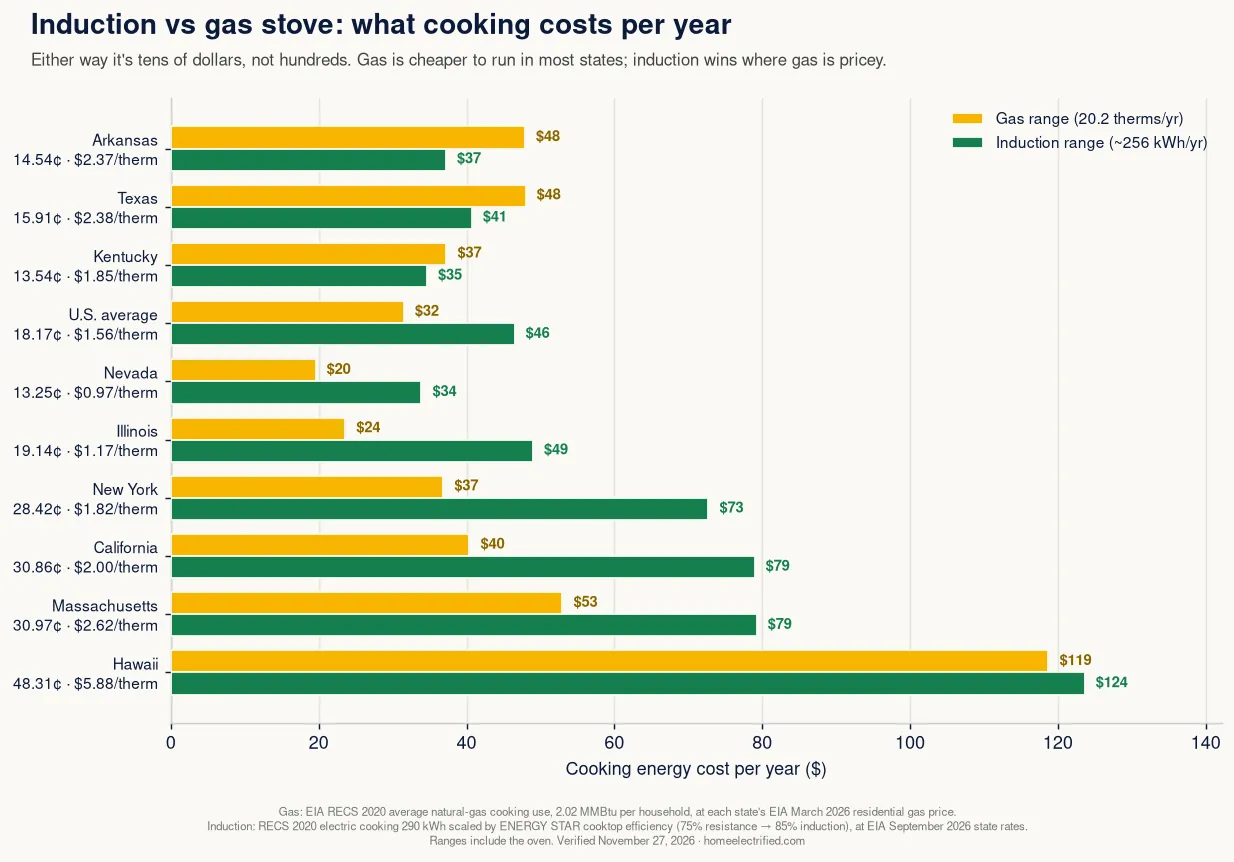
| State | Electricity | Gas (March 2026) | Gas range per year | Induction range per year | Induction vs gas |
|---|---|---|---|---|---|
| Arkansas | 14.54¢ | $2.37/therm | $48 | $37 | $11 cheaper |
| Texas | 15.91¢ | $2.38/therm | $48 | $41 | $7 cheaper |
| Kentucky | 13.54¢ | $1.85/therm | $37 | $35 | $3 cheaper |
| Arizona | 14.92¢ | $1.90/therm | $38 | $38 | about even |
| Mississippi | 14.47¢ | $1.79/therm | $36 | $37 | $1 more |
| Tennessee | 13.29¢ | $1.50/therm | $30 | $34 | $4 more |
| Hawaii | 48.31¢ | $5.88/therm | $119 | $124 | $5 more |
| Oregon | 15.73¢ | $1.74/therm | $35 | $40 | $5 more |
| Georgia | 16.27¢ | $1.78/therm | $36 | $42 | $6 more |
| Alabama | 16.64¢ | $1.72/therm | $35 | $43 | $8 more |
| Oklahoma | 15.22¢ | $1.54/therm | $31 | $39 | $8 more |
| Virginia | 17.74¢ | $1.81/therm | $37 | $45 | $9 more |
| West Virginia | 16.23¢ | $1.62/therm | $33 | $42 | $9 more |
| Kansas | 15.83¢ | $1.50/therm | $30 | $41 | $10 more |
| Missouri | 16.01¢ | $1.52/therm | $31 | $41 | $10 more |
| Nebraska | 13.87¢ | $1.16/therm | $24 | $35 | $12 more |
| Utah | 13.41¢ | $1.09/therm | $22 | $34 | $12 more |
| Nevada | 13.25¢ | $0.97/therm | $20 | $34 | $14 more |
| Delaware | 18.89¢ | $1.65/therm | $33 | $48 | $15 more |
| Iowa | 14.99¢ | $1.16/therm | $23 | $38 | $15 more |
| U.S. average | 18.17¢ | $1.56/therm | $32 | $46 | $15 more |
| Wyoming | 14.96¢ | $1.05/therm | $21 | $38 | $17 more |
| Indiana | 17.05¢ | $1.21/therm | $24 | $44 | $19 more |
| South Dakota | 16.31¢ | $1.08/therm | $22 | $42 | $20 more |
| New Mexico | 16.96¢ | $1.15/therm | $23 | $43 | $20 more |
| North Dakota | 14.29¢ | $0.80/therm | $16 | $37 | $20 more |
| Minnesota | 17.37¢ | $1.18/therm | $24 | $44 | $21 more |
| Maryland | 21.54¢ | $1.66/therm | $34 | $55 | $22 more |
| Idaho | 14.39¢ | $0.75/therm | $15 | $37 | $22 more |
| Ohio | 19.09¢ | $1.33/therm | $27 | $49 | $22 more |
| Colorado | 17.88¢ | $1.12/therm | $23 | $46 | $23 more |
| Montana | 15.69¢ | $0.82/therm | $17 | $40 | $24 more |
| Pennsylvania | 22.20¢ | $1.61/therm | $33 | $57 | $24 more |
| Illinois | 19.14¢ | $1.17/therm | $24 | $49 | $25 more |
| Massachusetts | 30.97¢ | $2.62/therm | $53 | $79 | $26 more |
| Vermont | 24.83¢ | $1.61/therm | $33 | $64 | $31 more |
| District of Columbia | 25.82¢ | $1.74/therm | $35 | $66 | $31 more |
| Connecticut | 27.09¢ | $1.89/therm | $38 | $69 | $31 more |
| Wisconsin | 19.42¢ | $0.92/therm | $18 | $50 | $31 more |
| New Hampshire | 29.17¢ | $2.05/therm | $41 | $75 | $33 more |
| New Jersey | 24.64¢ | $1.37/therm | $28 | $63 | $35 more |
| New York | 28.42¢ | $1.82/therm | $37 | $73 | $36 more |
| Michigan | 23.17¢ | $1.09/therm | $22 | $59 | $37 more |
| California | 30.86¢ | $2.00/therm | $40 | $79 | $39 more |
| Rhode Island | 29.93¢ | $1.50/therm | $30 | $77 | $46 more |
| Alaska | 28.00¢ | $1.25/therm | $25 | $72 | $46 more |
Gas range: 20.2 therms a year (RECS 2020 average for homes cooking with gas). Induction range: 256 kWh (RECS 2020 electric cooking, 290 kWh, scaled from 75% to 85% cooktop efficiency). State electricity: EIA September 2026; state gas: EIA March 2026, converted at 10.36 therms per thousand cubic feet. Sorted from most favorable to induction.
What stands out:
- Induction is cheaper in three states and about even in a fourth. Arkansas and Texas have the most expensive gas in the table outside Hawaii and Massachusetts ($2.37–$2.38 a therm) and moderate power, so induction saves $7–$11 a year. Kentucky saves about $3, and Arizona comes out even.
- The gap is widest where power is expensive and gas is not. In Alaska and Rhode Island induction costs about $46 a year more; in California and Michigan, $37–$39.
- Nowhere is it big money. The largest gap in either direction is under $50 a year, about 2% of the $2,250 extra an induction switch costs up front. Running cost alone will not pay for an induction range anywhere in this table, and it will not sink one either.
If you’d be giving up gas service entirely, the math changes: a gas line also carries a fixed monthly customer charge on your bill. That only goes away when the last gas appliance does, which is why stoves are usually swapped together with a heat pump or heat pump water heater rather than alone.
Gas stoves and indoor air: what the studies found
The health argument is where the two options differ most. A gas burner is an open flame in the kitchen, and what it burns ends up in the room unless a hood pulls it outside. Four peer-reviewed studies set out the scale:
- Nitrogen dioxide and asthma (Stanford, 2024). Kashtan et al. combined measurements in more than 100 homes with an indoor-air model and found that gas and propane stoves raise long-term NO₂ exposure by 4.0 parts per billion on average across the U.S., 75% of the World Health Organization’s guideline. They estimate this causes about 50,000 current cases of childhood asthma from long-term NO₂ alone. Short-term levels during typical cooking frequently exceeded WHO and EPA benchmarks. People in homes under 800 sq ft had about four times the long-term exposure of people in homes over 3,000 sq ft. (Science Advances)
- Share of childhood asthma (2022). Gruenwald et al. estimated that 12.7% of current childhood asthma in the U.S. (95% confidence interval 6.3–19.3%) is attributable to gas stove use, ranging up to 21.1% in Illinois. It’s a population-attributable-fraction estimate built on a meta-analysis odds ratio of 1.34, not a direct measurement, and two of the authors work at RMI, a clean-energy nonprofit. DOE cites it. (IJERPH)
- Benzene (Stanford, 2023). Across 87 homes in California and Colorado, gas and propane burners on high and ovens at 350°F emitted 2.8–6.5 micrograms of benzene a minute, 10 to 25 times the level from electric coil and radiant stoves. Induction emitted no detectable benzene. In some homes benzene drifted into bedrooms and stayed above chronic health benchmarks for hours. (Environmental Science & Technology)
- Methane and NOx, even when off (Stanford, 2022). Lebel et al. measured 53 homes and found gas stoves leak 0.8–1.3% of the gas they use as unburned methane, with more than three-quarters of it released while the stove is off. In households that don’t run a range hood or have poor ventilation, NO₂ can pass the one-hour national standard of 100 ppb within a few minutes of cooking, especially in small kitchens. (Environmental Science & Technology)
ENERGY STAR’s consumer guidance lists carbon monoxide, nitrogen oxides, formaldehyde and particulate matter from gas cooking. It notes that exposure can raise the risk of headaches, asthma and respiratory infections.
If you keep gas, ventilate. A 2025 modeling follow-up on benzene found that high-efficiency range hoods (75% capture or better) vented outdoors notably reduced exposure in the kitchen. Use the hood every time and open a window when you can. The benefit in that study came from hoods vented outdoors.
Induction stove rebates in 2026
There is no federal tax credit for a stove. The Section 25C credit that once covered heat pumps and panels never included cooking appliances, and it expired with 2025 anyway. What exists is a rebate, with conditions:
- HEEHR, up to $840. The IRA’s High-Efficiency Electric Home Rebate program (renamed from HEAR in 2026) lists up to $840 for an ENERGY STAR electric stove, cooktop, range or oven, per ENERGY STAR’s program page. It covers up to 100% of the cost below 80% of area median income and up to 50% at 80–150%. Households above 150% of AMI don’t qualify.
- No longer for replacing gas. DOE Program Notice 26-2 (effective May 29, 2026) removed rebates for fuel-switching. States now offer rebates only for upgrading from existing electric equipment to more efficient electric equipment, plus new construction. ENERGY STAR’s table lists the stove rebate for new construction, replacing an electric appliance, or a first-time purchase. Existing reservations made under the old rules can still be paid, but a new reservation to swap a gas range for induction won’t be approved. That’s the opposite of how most rebate roundups still describe this rebate.
- State by state. States choose which measures to offer, and funding varies. As of our October 30, 2026 check, California’s HEEHRA Phase I was fully reserved with no new reservations. See our heat pump rebates page for the current state-by-state status, and check your state energy office before you buy.
In practice, the $840 helps an income-qualified household replacing an old coil or radiant electric range with induction. That swap needs no new wiring, so the rebate can cover a real share of a $1,100–$4,300 project.
Pros and cons
Induction, pros
- Fastest: in Frontier Energy’s test, 9.3–11.6 minutes to bring 12 lb of water from 70°F to 200°F, against 18.6 minutes on a 17,000 BTU/h gas burner. DOE cites Consumer Reports finding induction boils water 20–40% faster.
- About 85% of the energy reaches the pot, and less waste heat goes into the kitchen.
- No combustion, so no NO₂, carbon monoxide or benzene from the cooktop.
- The glass surface only gets as hot as the pan on it, and most models shut off when no pan is detected (DOE).
- More precise, even heating, and a flat top that wipes clean (DOE).
Induction, cons
- Costs more: $1,000–$4,000 for the unit and usually about $700 for a circuit when replacing gas.
- Needs magnetic cookware.
- Usually slightly more expensive to run (about $15 a year at the U.S. average).
- No cooking in a power outage without backup power.
Gas, pros
- Cheapest to buy and install where a gas line already exists ($700–$1,600).
- Cheaper to run in most states, though by tens of dollars a year.
- Works with any cookware, and some cooks prefer an open flame for charring or a round-bottomed wok.
- HomeGuide notes gas ovens typically outlast electric ones (ovens last 10–20 years).
Gas, cons
- Indoor air pollution that needs a vented hood to manage (see the studies above).
- Slowest of the three in heat-up tests, and about 32% efficient.
- Leaks methane even when off.
- No federal rebate, and running gas to a kitchen that lacks it costs extra.
Induction vs gas oven
There’s no such thing as an induction oven. An “induction range” pairs an induction cooktop with a regular electric oven, the same radiant or convection oven you’d find in any electric range. So the oven comparison is electric vs gas. HomeGuide notes electric ovens hold more consistent temperatures, while gas ovens cost a little less to run per hour ($0.10–$0.30 against $0.15–$0.40) and typically last longer. The benzene study above measured gas ovens at 350°F as well as burners, so the indoor-air point applies to the oven too.
Verdict: should you switch?
- Your gas range still works and you’re not renovating: keep it, use a vented hood every time, and try a $70 plug-in induction burner if you’re curious. Paying $2,250 or more early to switch won’t come back through your bills.
- You’re replacing an old electric range: go induction. The 240-volt outlet is already there, entry-level models cost only a few hundred dollars more than a basic electric range, it’s faster, and it trims your bill slightly. If your household is under 150% of area median income, check for the $840 HEEHR rebate first.
- Your gas range is dying, or you’re remodeling: this is the moment to switch if you can afford it. You’re buying a range anyway, so induction only adds the circuit and the price difference, and you get faster cooking and cleaner air. It matters most with young children, someone with asthma, or a small home where pollutants concentrate.
- You’re electrifying the whole house: induction is the step that lets you drop gas service, and its fixed charge, once the furnace and water heater are electric. Plan the panel once for everything: see what a panel upgrade costs and how a heat pump compares with a gas furnace.
Methodology & sources
All figures verified November 27, 2026:
- Electricity rates: EIA Electric Power Monthly, Table 5.6.A, residential, September 2026 state data (released November 24, 2026; next release due December 23, 2026). U.S. average 18.17¢/kWh.
- Natural gas: EIA residential natural gas prices by state (release October 30, 2026, still the latest on November 27). March 2026 is used as the latest heating-season month: U.S. $16.16 per thousand cubic feet ≈ $1.56/therm at 10.36 therms per Mcf, the same basis as our heat pump vs gas furnace and electric furnace pages. Summer months show higher per-therm prices because fixed charges are spread over less gas.
- Cooking energy use: EIA RECS 2020, Table CE5.4 (natural gas cooking, 2.02 million BTU per household using it) and Table CE5.3b (electric cooking, 290 kWh per household using it). Cooking covers ranges, separate cooktops and separate ovens, excluding microwaves, small appliances and outdoor cooking.
- Efficiencies: ENERGY STAR Emerging Technology Award, residential induction cooking tops (gas ~32%, resistance 75–80%, induction ~85%); ENERGY STAR electric cooking fact sheet (2025); Frontier Energy, Residential Cooktop Performance and Energy Comparison Study (July 2019; efficiencies and heat-up times); DOE, Making the Switch to Induction Stoves or Cooktops (May 2023).
- Prices: HomeGuide oven and stove cost (updated January 2, 2026: range prices by fuel, labor, oven running cost, lifespan); HomeGuide dedicated circuit cost ($250–$900); Angi dedicated circuit cost (updated October 30, 2026: $700 average, $570–$1,000). Panel upgrade $1,300–$3,000, average $2,150 (This Old House), as registered on our panel upgrade cost page. Panel load from our panel upgrade explainer (2023 NEC 220.83).
- Rebates: ENERGY STAR, HEEHR program for states and territories (read November 27, 2026: $840 stove/cooktop/range/oven, eligibility rows, AMI rules); DOE Home Energy Rebates Program Notice 26-2 (effective May 29, 2026). California status from our October 30, 2026 check.
- Health: Kashtan et al., Science Advances, 2024; Gruenwald et al., International Journal of Environmental Research and Public Health, 2022; Kashtan et al., Environmental Science & Technology, 2023; Lebel et al., Environmental Science & Technology, 2022; Garg et al., Journal of Hazardous Materials, 2025 (range hoods); all read via their PubMed abstracts on November 27, 2026. ENERGY STAR fact sheet for the pollutant list.
- Assumptions: induction 85%, electric resistance 75%, gas 32% cooktop efficiency; induction range energy = RECS electric cooking × 0.75 ÷ 0.85 (an upper bound on the savings, since the oven doesn’t change); 1 kWh = 3,412 BTU, 1 therm = 100,000 BTU. Calculations:
scripts/stove-2026-11/model.py. We did not test any stoves; all figures come from the published sources above. - Planning figures, not quotes. Your cost depends on your utility rates, how much you cook and your kitchen’s wiring.
Energy prices change monthly; this page is re-verified on a schedule, and the “verified” date shows the latest check.
Frequently asked questions
Is induction cheaper to run than gas?
Usually not, but the gap is small. At U.S. averages (18.17¢/kWh electricity, $1.56/therm gas) an induction range costs about $46 a year to run versus about $32 for a gas range, roughly $15 a year or $1.25 a month more. Induction comes out cheaper in Arkansas, Texas and Kentucky, where gas is expensive relative to electricity, and is about even in Arizona.
How much does an induction stove cost compared with gas?
HomeGuide prices induction ranges at $1,000 to $4,000 for the unit, against $600 to $1,300 for a gas range and $700 to $1,100 for a standard electric range, plus $100 to $300 for installation labor. Switching from gas usually also needs a new 240-volt circuit, which Angi puts at $570 to $1,000 (about $700 on average).
Do I need a new circuit or panel for an induction stove?
If you are replacing a gas range, almost certainly a new 240-volt circuit, because a gas range plugs into an ordinary 120-volt outlet. Whether you also need a panel upgrade depends on your service size and other loads. In our 100-amp load calculation an induction range takes the home from about 71 to 87 amps, which still fits; a 100-to-200-amp panel upgrade averages about $2,150 (This Old House) if it doesn't.
Is there a rebate for an induction stove in 2026?
The federal HEEHR program (formerly HEAR) lists up to $840 for an ENERGY STAR electric stove, cooktop, range or oven, for households under 150% of area median income, where your state offers it. Since DOE Program Notice 26-2, new reservations can't fund replacing a gas appliance; the rebate covers replacing an electric appliance, new construction or a first-time purchase. There is no federal tax credit for stoves.
Are gas stoves bad for your health?
They add combustion pollutants to indoor air. A 2024 Stanford study estimated gas and propane stoves raise long-term nitrogen dioxide exposure by 4.0 ppb on average across the U.S., about 75% of the WHO guideline, and attributed about 50,000 current cases of childhood asthma to it. A 2023 study measured benzene from gas burners and ovens at 10 to 25 times the level of electric coil or radiant stoves, with none detected from induction. A range hood vented outdoors cuts exposure.
Is induction faster than gas?
Yes. In Frontier Energy's 2019 test for California utilities, three induction cooktops brought 12 pounds of water from 70°F to 200°F in 9.3 to 11.6 minutes, against 18.6 minutes for a high-output 17,000 BTU/h gas burner. Induction moved about 85% of its energy into the pot, gas about 32%.